Card images
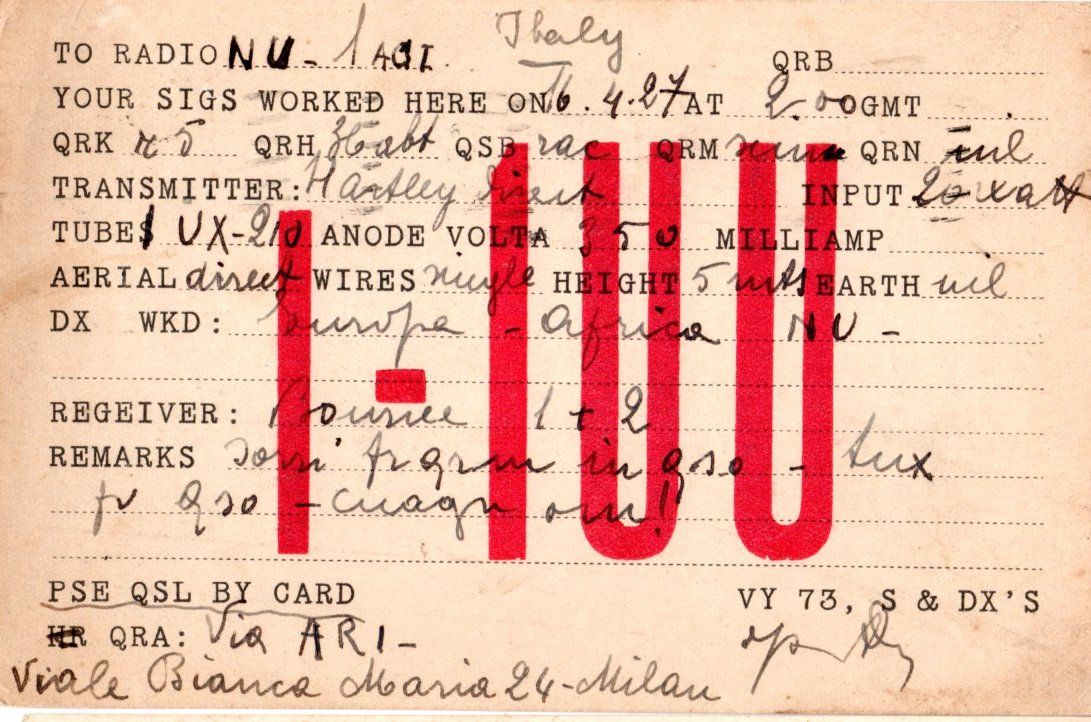
I1UU
- Operator
- Agostino Criscuoli
- QSO Date
- 1927-04-16
- QSO Time
- 20:00 GMT
- Mode
- CW
- Band
- 40m
i1UU – Agostino Criscuoli, Turin: Twenty Watts and a UX-210
Introduction
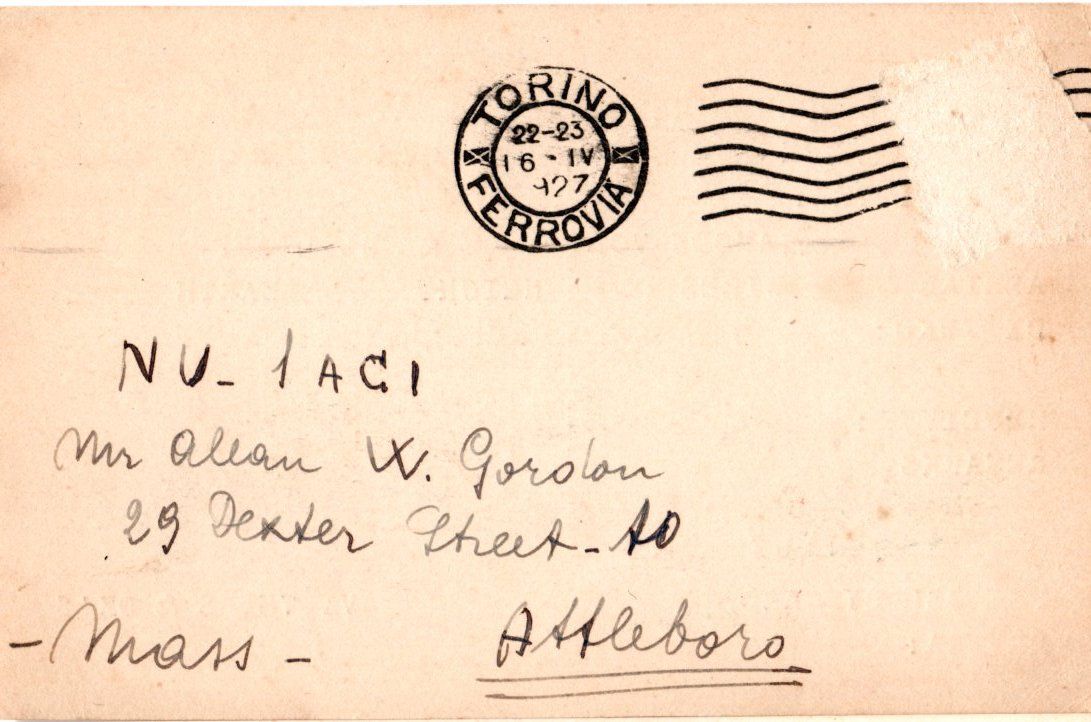
The card is signed with an illegible flourish and gives as its address only "via ARI – Viale Bianca Maria 24 – Milan", but Il Radio Giornale identifies the station: its list of Italian transmitters of October 1927 reads "1UU - Agostino Criscuoli, Via Leyni, 52, Torino", and Franco Marietti, in the same issue, calls him "1UU Agostino Criscuoli, ottimo dilettante, perfetto conoscitore del Morse e, sopratutto, un dilettante serio". The card, postmarked Torino Ferrovia on 16 April 1927, confirms a contact that morning at 02:00 GMT on 36 metres with nu1ACI, Allan W. Gordon of 29 Dexter Street, Attleboro, Massachusetts, an American whom three other stations in this collection (1ER, 1GW and 1AU) also worked.
A low-power DX station (1927–1928)
1UU is not mentioned before the spring of 1927. He enrolled in the A.R.I. 1927 contest on 20 April 1927, four days after this card, and the monthly reports that followed are those of a very modest station with excellent results:
- May 1927: "Elenco dei QSO DX del mese di maggio con potenza di 15 watt in grafia. NU: 1ACH; 1AMN; 2CNQ; 3CKL; 9BPL; 8CPF; 9ADG. OZ: 2AE. SB: 1AW. ARDI: Piroscafo incrociante nel canale di Panama che mi pregò di transitare un messaggio per Friedrichsvern (Norvegia)."
- June 1927: "QSO DX effettuati nel mese di giugno sempre potenza di 15 watt in grafia (valvola usata in trasmissione «Radiotron» UX 210). U.S.A.: Numerose stazioni. Giamaica: nj-2PZ; Costarica: nr-2FG; Chile: sc-2AR; Uraguay: su-2AK; Brasile: sb-2AS; Sud Africa: fo-AQA; Australia: oa-7CU; Nuova Zelanda: oz-2AC; 2GA; 3AJ; 3AR; 4AA." And: "Il 2 giugno alle ore 5 GMT 1UU con potenza di 8 watt entrava in QSO con xnu-WNP, Schooner Bowdoin, ancorato in Sheem Arbor, Nuova Scozia … 1UU usa il raddrizzatore elettrolitico, senza filtro, costituito da 14 celle."
- July 1927: "QSO DX del mese di luglio, validi per il concorso. Potenza 12-15 watt. Gruppi 7." The Turin section reported: "si segnala per la sua attività e gli ottimi risultati raggiunti 1UU, che con un UX 210 e una ventina di watt compie regolarmente tutti i DX … usando un tale triodo a forte assorbimento di corrente 1UU sia riuscito a ottenere una nota di purissima corrente continua, alimentando in corrente alternata raddrizzata con elettrolitici e con un solo microfarad al filtro."
In August 1927 Criscuoli was the Turin end of the radio link that Marietti ran from the university students' camp at Passo Sella: "il regolare collegamento radio con Torino ove la stazione corrispondente era 1UU", on 32–33 m, with signals "fra r7 e r9". Through 1927 he was heard in Spain, Great Britain, Germany, France, Moscow, Bolivia and, in December 1927, in Australia ("da I. D. Miller, Dulwich Hill, N.S.W.: 1UU"); one listener noted "1UU (fonia meravigliosa)".
In the final classification of the A.R.I. 1927 contest (June 1928, page 29) 1UU is fourth overall, third in the monthly telegraphy class, behind Marietti (1NO), Marzoli (1MA) and Quasimodo (1CR), with no telephony entries. He returned to the key in the summer of 1928 "in vyqrp": "Quando la notte del 18 luglio dalle 2 alle 3 effettuai le bilaterali con NU-3LW, NU-8HX e NU-2WI con alimentatore di 6 watt mi meravigliai non poco … una bilaterale con OZ-2GA con la stessa alim. il giorno 25 agosto alle 5.20 GMT. OZ-2GA di Wellington mi diceva: ur qrk r 4-5. La valvola adoperata è la Telefunken RE-134, alimentata con 200 volt di accumulatori … Il circuito è l'Hartley, lo stesso usato per il concorso ARI 1927. L'onda di lavoro: 33 metri circa" (September 1928).
The card itself
- To: nu1ACI, Mr Allan W. Gordon, 29 Dexter Street, Attleboro, Mass. "Your sigs worked here on 16.4.27 at 2.00 GMT", QRK r5, QRH 36 m, QSB rac, QRM nil, QRN nil.
- Transmitter: Hartley direct, input 20 watts, 1 UX-210, 350 V on the anode. Receiver: Bourne 1 + 2.
- Aerial: direct, single wire, 5 m high, no earth. DX wkd: Europa – Africa – NU.
- Remarks: "sorri fr QRM in QSO – tnx fr QSO – cuagn OM!"; "pse QSL by card"; "HR QRA: via ARI – Viale Bianca Maria 24 – Milan".
The card's Hartley, UX-210 and 20 watts are exactly the station described by the magazine in June and September 1927.
Key Specifications of 1UU
| Component | Description |
|---|---|
| Location | Via Leyni 52, Turin |
| Operator | Agostino Criscuoli |
| Power | 12–20 W (1927); 8 W to the Bowdoin (June 1927); 6 W to the USA and New Zealand (summer 1928) |
| Wavelengths | 36 m (card); 32–33 m |
| Antenna | Single wire, 5 m high, no earth |
| Equipment | Hartley with Radiotron UX-210, electrolytic rectifier of 14 cells; Telefunken RE 134 on 200 V of accumulators (1928); Bourne receiver, 1 + 2 |
| Achievements | New Zealand, Australia, South Africa, Jamaica, Costa Rica, Chile, Uruguay and Brazil with 15 W (May–June 1927); MacMillan's schooner Bowdoin with 8 W; 4th in the A.R.I. 1927 contest; Turin terminal of the Passo Sella camp link (Aug 1927) |
Sources
- Il Radio Giornale, May, June, July, August, September (section report), October (pp. 8, 32, 37: Passo Sella article, list of transmitters, section report), November and December 1927; January, March, June (p. 29, contest classification), September and October 1928; scans at introni.it.
- Amateur Radio Stations of the United States, June 1927, and Radio Amateur Call Book, September 1928: 1ACI, Allan W. Gordon, 29 Dexter St., Attleboro, Mass.
- The card itself (front and back), K1FM collection.