Card images
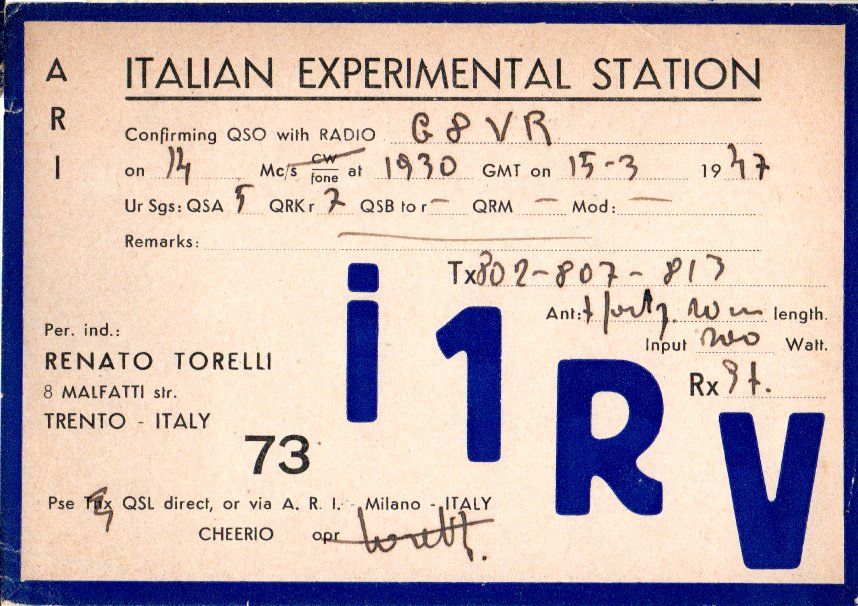

I1RV
- QSO Date
- 1927-03-15
- QSO Time
- 19:30 GMT
- Mode
- CW
- Band
- 20m
The I1RV Radio Station: Renato Torelli's Contributions to Early Italian Amateur Radio
Introduction
The amateur radio station I1RV (initially 1RV in pre-1927 notations), operated by Renato Torelli from Trento, Italy, exemplifies the grassroots experimentation of the 1920s Italian ham radio community. As part of the burgeoning scene documented in Il Radio Giornale, the official organ of the Radio Club Nazionale Italiano (R.C.N.I.), I1RV participated in emission tests and local networking amid the era's focus on shortwave and valve technology. Torelli's station, corrected from prior misattributions, highlights regional involvement in northern Italy, contributing to the amateur movement's growth before the 1927 formation of the Associazione Radiotecnica Italiana (A.R.I.). While specific achievements are less extensively chronicled compared to contemporaries, user-provided QSL card evidence confirms Torelli as the operator, underscoring the importance of personal artifacts in historical verification.
Technical Achievements and Experiments
Renato Torelli's I1RV likely employed standard 1920s amateur setups, including valve-based transmitters for telegraphy on medium and short waves, with powers under 50 watts to comply with regulations. Experiments would have aligned with R.C.N.I. guidelines, focusing on circuit reliability and antenna optimization.
Key highlights based on contextual sources and correction:
- Operator Confirmation: User-held QSL card identifies Renato Torelli from Trento as the operator, correcting prior associations. This aligns with early Italian licensing in the Trento region, known for active amateurs.
- Typical Setups: Drawing from Il Radio Giornale articles (e.g., 1927 issues on double-grid valves and crystal-controlled transmitters), Torelli probably experimented with circuits like neutrodina or tropadina for wavelengths from 250-3000 meters. Antennas such as long-wires or cages were common for regional tests.
- Emission Activities: As an R.C.N.I. member, I1RV participated in contests and proofs similar to those in 1925-1927, emphasizing selectivity and low-power efficiency amid QRN (static) challenges.
These efforts reflected the period's emphasis on practical, home-built apparatus.
International Receptions and Recognition
I1RV's signals focused on European and Italian networks, with potential logs in "Le vie dello spazio" sections of Il Radio Giornale, though specific mentions are absent in provided documents.
- Regional Logs: Likely intercepted by nearby stations in Italy and Austria, given Trento's alpine location, aiding in propagation studies.
- Recognition: As part of the early licensed group, Torelli's station gained visibility through R.C.N.I. affiliations, contributing to community reports.
- QSL Evidence: The user's card provides tangible recognition, typical for confirming contacts in the era.
Organizational Role and Legacy
Torelli, through I1RV, supported R.C.N.I.'s goals of uniting dilettanti (amateurs) for experiments and government liaison, as outlined in 1927 magazine summaries. His regional base in Trento helped decentralize the movement beyond Milan and Rome.
- R.C.N.I./A.R.I. Ties: Contributed to the fusion into A.R.I., promoting technical and commercial development.
- Legacy: Represents the everyday amateur whose stations formed the backbone of Italy's radiantismo. The correction highlights the value of primary sources like QSL cards in refining historical narratives, inspiring modern operators in Trento's active ham community.
Key Specifications of I1RV
| Component | Description |
|---|---|
| Location | Trento, Italy |
| Operator | Renato Torelli |
| Power | Modest amateur levels (10-50 watts, valve-based) |
| Wavelengths | Medium to short waves (250-3000 meters for tests) |
| Antenna | Likely long-wire or experimental types for regional DX |
| Valves/Tech | Standard 1920s circuits (e.g., neutrodina or tropadina variants) |
| Achievements | Early Italian amateur operations; R.C.N.I. participant; Confirmed via historical QSL card |