Card images
I1RG
- Operator
- Ernesto Montu
- QSO Date
- 1925-05-11
- Band
- 20m
i1RG – Ernesto Montù and the Radiogiornale Station, Bellagio: Italy's First Contact with New Zealand

Introduction
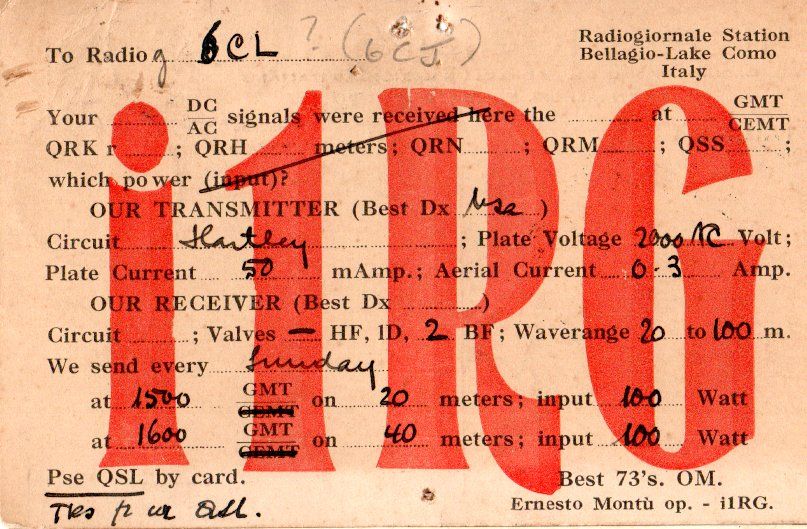
1RG was the experimental station of Il Radio Giornale, the magazine founded and edited by Ing. Ernesto Montù (Alessandria, 3 January 1893 – Santa Margherita Ligure, 1981), organ of the Radio Club Nazionale Italiano and, from 1927, of the A.R.I., of which Montù was a founder and secretary for twenty years. The card is printed "Radiogiornale Station, Bellagio – Lake Como, Italy" and signed "Ernesto Montù op. i1RG"; the magazine itself only names Bellagio from September 1926 ("1RG a Bellagio", in a letter of Marietti), and the Como congress of September 1927 ended with a boat trip "a Bellagio dove visitarono il laboratorio dell'Ing. Montù". The administrative address on the back is that of the magazine, Viale Maino 9, Milan.
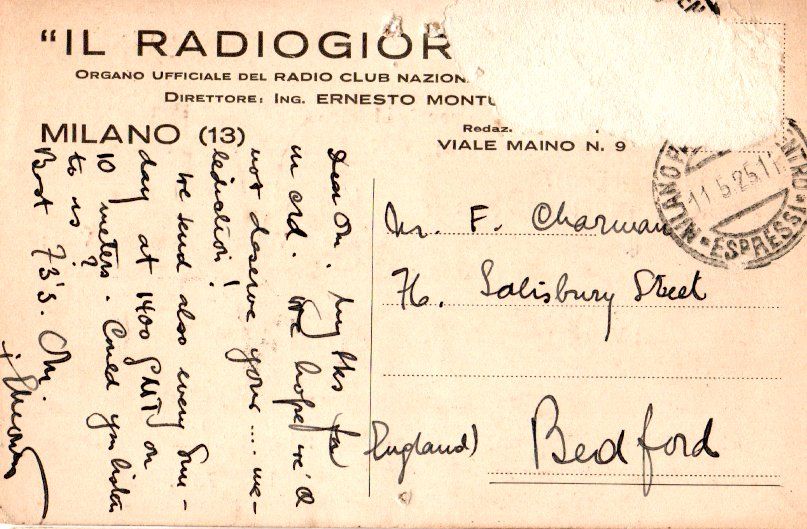
The card was sent by express from Milan on 11 May 1925 to Mr F. Charman, 76 Salisbury Street, Bedford (g6CL, with "6CJ?" added), in reply to a reception report: "Dear OM, many tks fr ur crd. We hope u'll receive our … We send also every Sunday at 1400 GMT on 10 metres. Could you listen to us?" It is one of the earliest cards of the station, written three weeks before its most celebrated contact.
Spring 1925: 65, 40 and 20 metres
"La stazione i1RG (Radio-giornale) inizierà quanto prima esperimenti di emissione" (March 1925, page 16). In April the magazine listed the first two-way contacts "(30 watt alimentazione 65 m.)" with i1CO, n0GG, f8CS, fn3NM, f1OKZ, b4SR, g5SZ and b4RS, and reception in Great Britain on 40 m. The May 1925 issue (pages 11–12), in the article "La stazione sperimentale del Radiogiornale", gives the coil data for 15–30, 30–45 and 60–90 m and describes the aerial: "a L a tratto orizzontale bifilare … lungo circa 30 metri e alto circa 15 m", earthed "mediante rete metallica sotterrata"; "1RG (Radiogiornale) ha stabilito il 17 e il 19 aprile una comunicazione bilaterale con G2FN (Baker, Nottingham) su 20 metri alle ore 15 con soli 100 watt alimentazione". The Sunday schedule of that month, "0700 (TEC) su 45 m; 1500 su 10 m; 1600 su 20 m; 1700 su 45 m", is the one printed on this card (1500 GMT on 20 m, 1600 on 40 m, 100 W input, and the 10 m transmissions mentioned on the back).
31 May 1925: New Zealand and Argentina
The June 1925 editorial is headed "1RG comunica bilateralmente con Neo Zelanda e Argentina": "Il 31 Maggio u.s. 1RG, rispondendo a una chiamata generale di 4AK ha stabilito con tale stazione una comunicazione bilaterale su 40 m. circa a partire dalle ore 6,30 sino alle ore 8", with "200 Watt (2000 Volt con 100 mA)", and a telegram from Buenos Aires (CB8, Braggio): "Udito chiamata prego ripeterla". A second New Zealand contact followed on 7 June with z2XA, and in July the magazine listed z4AK, z2XA and z2AE worked on 35 m and reception in Victoria, Australia, on 7 June.
The priority was disputed. Marietti wrote that the first Italy–New Zealand bilateral had been made by 1ER (Santangeli) on 31 May and that 1RG had only worked 4AK on 14 June; QST of September 1925 printed the same version. The magazine replied (September 1925, page 3): "Teniamo a ripetere ciò che è stato già comunicato a suo tempo e cioè che la prima bilaterale 1RG – z4AK ha avuto luogo il 31 maggio e quindi contemporaneamente, a quanto pare, a quella 1ER – z2XA". Its table of Italian DX firsts (May 1926, page 17) lists both contacts at 05:00 GMT on 31 May 1925 as the joint "prima bilaterale telegrafica Italia-Nuova Zelanda", credits 1RG with "prima ricezione di un Italiano in Argentina" (CB8, 30 May 1925) and "prima ricezione telegrafica di un Italiano in Australia" (14 June 1925), and the March 1926 editorial calls 1RG the station "cui spetta il merito di avere per primo in Italia indagati i campi di 20 e 40 metri". Giulio Salom (December 1925) also credited 1RG with the first bilateral.
Telephony (from October 1925)
"Dopo le prime comunicazioni telegrafiche con la Nuova Zelanda, l'Australia e il Sud America il lavoro telegrafico non ci interessò più e ci dedicammo … alla trasmissione radiotelefonica", Montù wrote in November 1927. The September 1925 article on the station announced phone tests from October and reported a wavelength of 10 m reached with the new circuit; the October 1925 article "Prove radiotelefoniche di 1RG" describes the modulator: "abbiamo usato come valvola oscillatrice una valvola trasmettente Huth tipo LS87 e come valvola modulatrice … una valvola Philips normale del tipo D II", with grid modulation, phone every Sunday at 16:00 on 18 m and at 07:00 and 17:00 on 38 m. "1RG è stato ricevuto in telefonia a Harrow (Inghilterra) con intensità r7-8 su 38 m. di giorno con ottima modulazione: Potenza alimentazione 100 Watt"; in November 1925 a Yugoslav amateur answered in telegraphy and u3PH of Baltimore heard the phone on 18 October; a London listener in January 1926 reported "i vostri segnali telefonici su 10 m. circa con intensità r8 … Siete la sola stazione ricevuta sotto i 15 metri". The schedule in the winter of 1925–26 was 12 m at 14:00 GMT, 18 m at 15:00 and 36 m at 16:00, announced "qui 1RG – Radiogiornale". The supply was "200 Watt a 2500 Volt alternati" on the Huth L.S. 87 (December 1925). From 1926 1RG transmitted "solo telefonia" on Sundays and later on Saturday evenings on 55–61 m, with 34–45 m on Sundays, and by 1927 used a Telefunken RS 228 fed from accumulators to cure dynamo noise; its phone was heard as far as Irkutsk (1927).
Montù founded the Radio Club Lombardo in February 1924 (station 1RCL), which became the R.C.N.I.; he was the first secretary of the A.R.I. (president Giuseppe Pession) and later its honorary president, and the author of the Hoepli manuals Come funziona e come si costruisce una stazione radio and, with De Colle, Ricevitori supereterodina; the "Tropadina" receiver described in the magazine in 1926 was his design.
The card itself
- To: g6CL ("6CJ?"), Mr F. Charman, 76 Salisbury Street, Bedford, England; express from Milan, 11 May 1925.
- Our transmitter: Hartley, plate 2,000 V AC, plate current 50 mA, aerial current 0.3 A. Our receiver: 1 D, 2 BF, 20 to 100 m.
- "We send every Sunday at 1500 GMT on 20 metres, input 100 watt; at 1600 GMT on 40 metres, input 100 watt"; "Best DX" and signal fields left blank; "Tks fr ur QSL"; "Pse QSL by card. Best 73's OM. Ernesto Montù op. i1RG".
- Back: "Il Radiogiornale, Organo ufficiale del Radio Club Nazionale Italiano, Direttore Ing. Ernesto Montù, Milano (13), Viale Maino 9"; the note quoted above about the 10 m transmissions.
Key Specifications of 1RG
| Component | Description |
|---|---|
| Location | Montù's laboratory at Bellagio, Lake Como; administration at the magazine, Viale Maino 9, Milan |
| Operator | Ing. Ernesto Montù (1893–1981), founder and editor of Il Radio Giornale, founder of the Radio Club Lombardo / R.C.N.I. and of the A.R.I. |
| Power | 30 W (first tests, 65 m); 100 W input (20 m, April–May 1925); 200 W, 2,000 V x 100 mA (New Zealand, May 1925); 200 W at 2,500 V on the Huth LS87 (phone, 1925) |
| Wavelengths | 65, 45, 40, 20 and 10 m (1925); 12, 18, 36–38 m phone (1925–26); 34–45 and 55–61 m (1926–27) |
| Antenna | L, two-wire horizontal section 30 m long, 15 m high; buried mesh earth, later a two-wire 30 m counterpoise |
| Equipment | Hartley (card); Huth LS87 oscillator with Philips D II grid modulator (1925); Telefunken RS 228 (1927); 1D 2BF receiver 20–100 m |
| Achievements | First Italy–New Zealand two-way contact (z4AK, 31 May 1925, shared with 1ER); first Italian heard in Argentina (30 May 1925) and in Australia (14 June 1925); first Italian station on 20 and 40 m and on 10 m telephony |
Sources
- Il Radio Giornale, March 1925, p. 16; April 1925; May 1925, pp. 11–12; June 1925 (editorial and "Le vie dello spazio"); July, August, September (p. 3 and p. 10), October (p. 12), November and December 1925; January, March, April, May (p. 17), June–August 1926; September 1926 (Marietti's letter: "1RG a Bellagio"); scans at introni.it.
- Il Radio Giornale, September and October 1927 (Como congress visit to 1RG at Bellagio), November 1927, p. 16 ("La stazione 1RG"), 1927–28 telephony schedules and reception lists; scans at introni.it.
- QST, September 1925 (first Italy–New Zealand contacts; "i1RG, the station owned by Il Radiogiornale at Milan").
- Italian Wikipedia, "Ernesto Montù"; Federico Paoletti, Storia della radiodiffusione in Italia (federicopaoletti.it), entry for 5 February 1924 (Radio Club Lombardo).
- The card itself (front and back), K1FM collection.