Card images
I1ER
- Operator
- Mario Santangeli
- QSO Date
- 1925-05-13
- QSO Time
- 01:48 GMT
- Mode
- CW
- Band
- 40m
1ER – Ing. Mario Santangeli, Milan: A Reception Report from the Month of the First Italy–New Zealand Contact

I1ER (Mario Santangeli) with W2PAK and I1ACD (Adriano Ducati) in CQ, June 1953.
Introduction
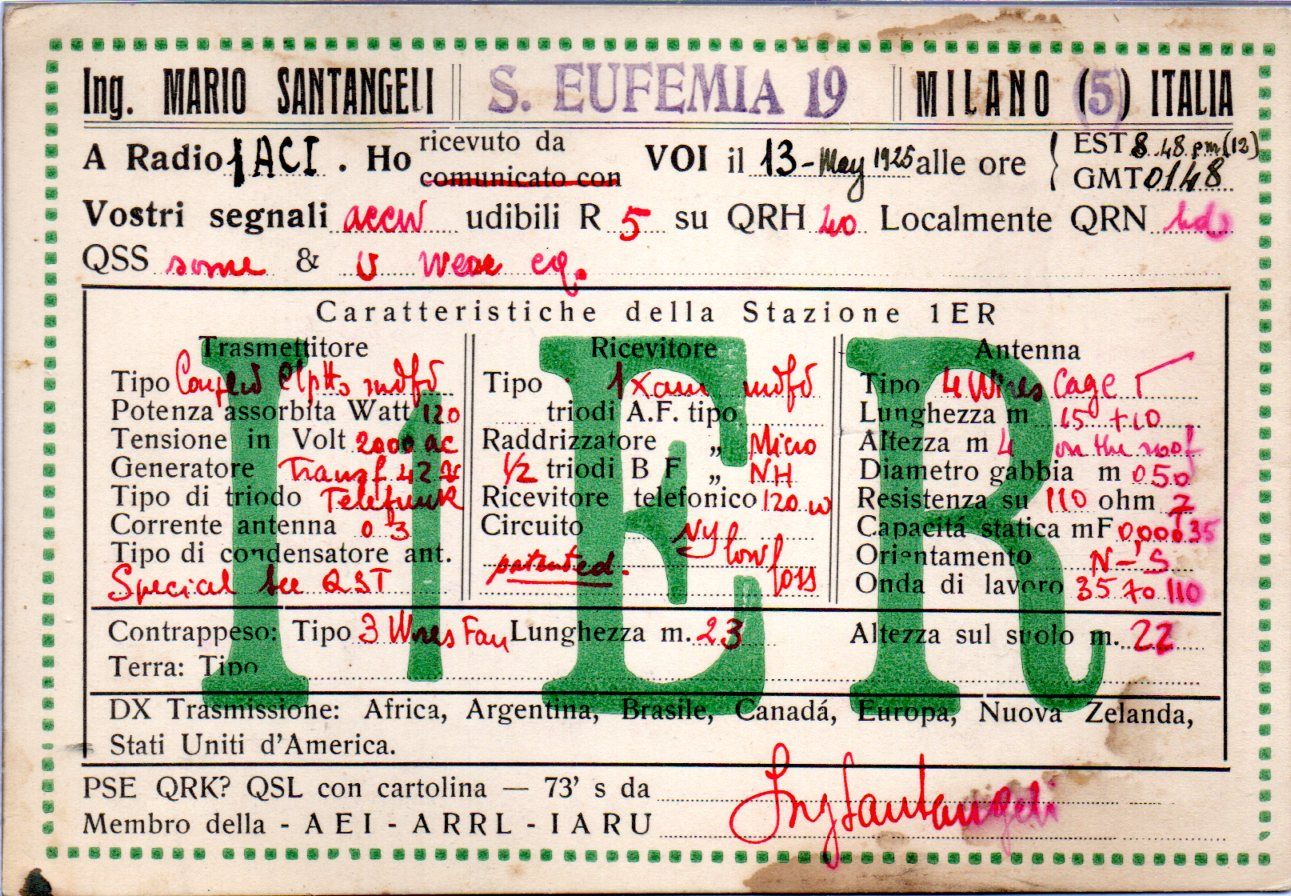
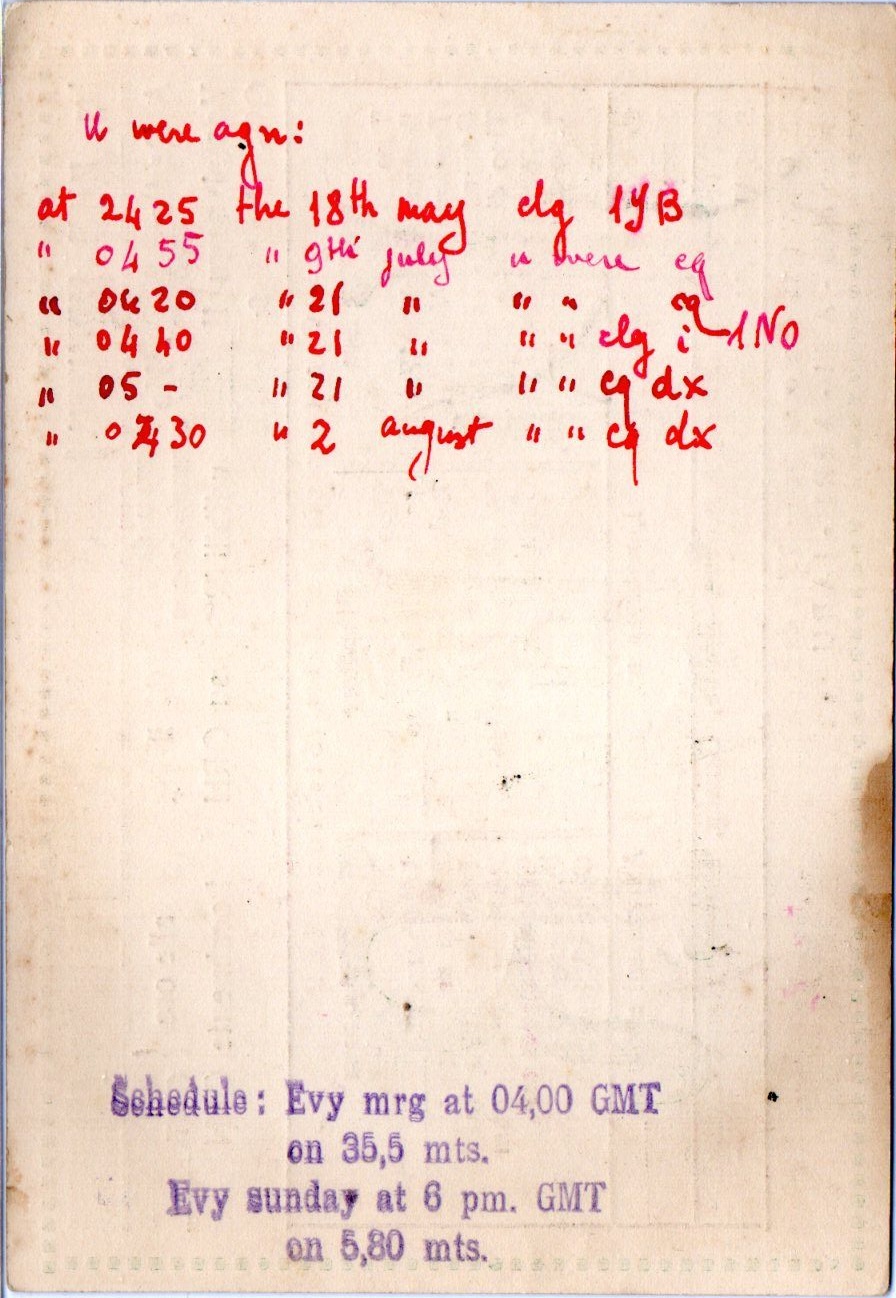
This card from Ing. Mario Santangeli's 1ER, in Via S. Eufemia 19, Milan, is a reception report: it tells u1ACI, Allan W. Gordon of Attleboro, Massachusetts, that his "ac cw" signals calling CQ were heard at R5 on 40 metres on 13 May 1925 at 8.48 pm Eastern time, 01:48 GMT, with bad atmospherics and some fading. Gordon was heard again on 18 May calling 1YB, on 9 and 21 July (once calling i1NO) and on 2 August; the list is added in red ink on the back. Two and a half weeks after the first reception, on 31 May 1925, 1ER made the contact for which it is remembered: the first two-way between Italy and New Zealand.
The station on the card
The card is a printed specification sheet, "Caratteristiche della Stazione 1ER", filled in by hand. Transmitter: "coupled Colpitts modified", 120 W absorbed, 2,000 V AC from a 42-cycle transformer, Telefunken triode, aerial current 0.3 A, "special aerial condenser, see QST". Receiver: a modified circuit with "Micro" rectifier and "NH" audio valves, "ny low loss, patented". Antenna: 4-wire cage, 15 + 10 m long, 4 m above the roof, 0.50 m diameter, 110 ohm resistance, 0.00035 mF static capacity, oriented N–S, working wave 35 to 110 m; counterpoise 3-wire fan, 23 m long, 22 m above the ground. "DX Trasmissione: Africa, Argentina, Brasile, Canadà, Europa, Nuova Zelanda, Stati Uniti d'America"; "Membro della AEI – ARRL – IARU". The rubber-stamped schedule on the back, "Evy mrg at 04,00 GMT on 35,5 mts. Evy sunday at 6 pm GMT on 5,80 mts", shows that in 1925 Santangeli was already experimenting on 5 metres: in May 1926 Brunacci (1GW) counted "i1ER, f8BF, u1CKP, Reinartz" among those who had "veramente, metodicamente e lungamente studiato tale onda".
1ER in Il Radio Giornale and QST
Santangeli's signals were being logged in Rome and Turin on 150–200 m in the spring of 1924, in London (Chatham, Blackheath) and the United States by November 1924, and in Great Britain and France at R8 in April 1925. QST of September 1925 reported: "For the first time communication was established between Italy and New Zealand when, on the morning of May 31st, i1ER worked z2XA. 2XA is the station of Mr. E. A. Shrimpton at Wellington, N.Z. … Then on June 14th i1RG … was QSO z4AK", and printed 1ER's log, "all in 40 meter band", with Australian, New Zealand and Brazilian calls. Il Radio Giornale, whose own station 1RG claimed a contact with z4AK on the same morning, printed Marietti's letter supporting 1ER's priority and replied that the two contacts had been "contemporaneamente, a quanto pare" (September 1925, page 3). Its table of Italian DX firsts (May 1926, page 17) lists both "31 Magg. 1925 0500 i1ER Santangeli … con z2XA Shrimpton Nuova Zelanda" and 1RG–z4AK as the joint first Italy–New Zealand bilateral. Giulio Salom and Ducati also debated the question in print; Santangeli, in January 1926, objected to a notice that had him on 38 m: "io sono sempre sotto i 35 metri e se fui sui 40 per qualche notte era a scopo di studio".
In New Zealand R. W. Mintrom of Christchurch logged 1ER fifteen times up to 8 January 1926, second only to 1MT; in 1926 the station was heard by u9AKF, u3QT, u7BB, u2AER, in Australia by Harris and a3LP, in Sweden ("1ER – telefonia (R6 – telegrafia R9)"), Uruguay and Austria, and the London listener I. Hum wrote that 1ER and 1RG were the best Italian signals. In 1927–28 the call is in the reception lists of British Guiana, Cameroon, Tasmania, Memphis, Pittsburgh and Wellington. Santangeli received one of the first official licences ("1ER Ing. Santangeli Mario – Milano", expiring 20 August 1928), and at the Volta exhibition in Como in September 1927, on the stand of Standard Elettrica Italiana, "l'ing. Santangeli illustrò minutamente il diffusore di 5 Kw. appositamente installato per la Mostra", the first record of the professional career in broadcast engineering that the 1953 CQ photograph above, taken with Adriano Ducati (I1ACD) and the American W2PAK, belongs to. The statements found in earlier versions of this page about a 1919 spark transmitter, 1922 phone tests with Ducati, a 1924 contact with New Zealand on 80 m, 10 m contacts with the USA in 1926 and post-war VHF and UHF work could not be verified in the magazine and are not repeated here.
The card itself
- To: Radio 1ACI (Allan W. Gordon, 29 Dexter Street, Attleboro, Mass., in the 1926–28 US lists). "Ho ricevuto da voi il 13 May 1925 alle ore EST 8.48 pm / GMT 0148. Vostri segnali ac cw udibili R5 su QRH 40. Localmente QRN bad, QSS some & u were cq."
- Station: as described above.
- Back: "u were agn: at 2425 the 18th May clg 1YB; 0455 9th July u were cq; 0420, 0440 (clg i1NO), 05– 21 July cq dx; 0430 2 August cq dx"; stamped schedule on 35.5 m and 5.80 m.
- "PSE QRK? QSL con cartolina – 73's da Ing. Santangeli".
Key Specifications of 1ER
| Component | Description |
|---|---|
| Location | Via S. Eufemia 19, Milan |
| Operator | Ing. Mario Santangeli; member of A.E.I., A.R.R.L. and I.A.R.U.; licensed 1927 |
| Power | 120 W input, 2,000 V AC at 42 cycles |
| Wavelengths | 35–110 m working range; 35.5 m daily; 40 m (New Zealand, May 1925); 5.80 m on Sundays |
| Antenna | 4-wire cage 15 + 10 m, 0.5 m diameter, 4 m above the roof, N–S; 3-wire fan counterpoise 23 m, 22 m above ground |
| Equipment | Coupled Colpitts, Telefunken triode, special aerial condenser; low-loss receiver with "Micro" rectifier |
| Achievements | First Italy–New Zealand two-way contact (z2XA, 31 May 1925, shared with 1RG); Africa, Argentina, Brazil, Canada, New Zealand and USA worked by mid-1925; heard fifteen times in New Zealand by January 1926; early 5-metre experiments |
Sources
- Il Radio Giornale, May, August, November and December 1924 (first receptions); April, June, September (p. 3), October, November and December 1925; January, March, May (pp. 17, 22), July, September and October 1926; scans at introni.it.
- Il Radio Giornale, October 1927 (licence table, list of transmitters, Volta exhibition) and 1927–28 reception lists; scans at introni.it.
- QST, September 1925 (first Italy–New Zealand contact; log of i1ER); scans at worldradiohistory.com.
- Amateur Radio Stations of the United States, June 1926 and June 1927: 1ACI, Allan W. Gordon, Attleboro, Mass.
- CQ, June 1953, p. 41 (photograph).
- The card itself (front and back), K1FM collection.