Card images
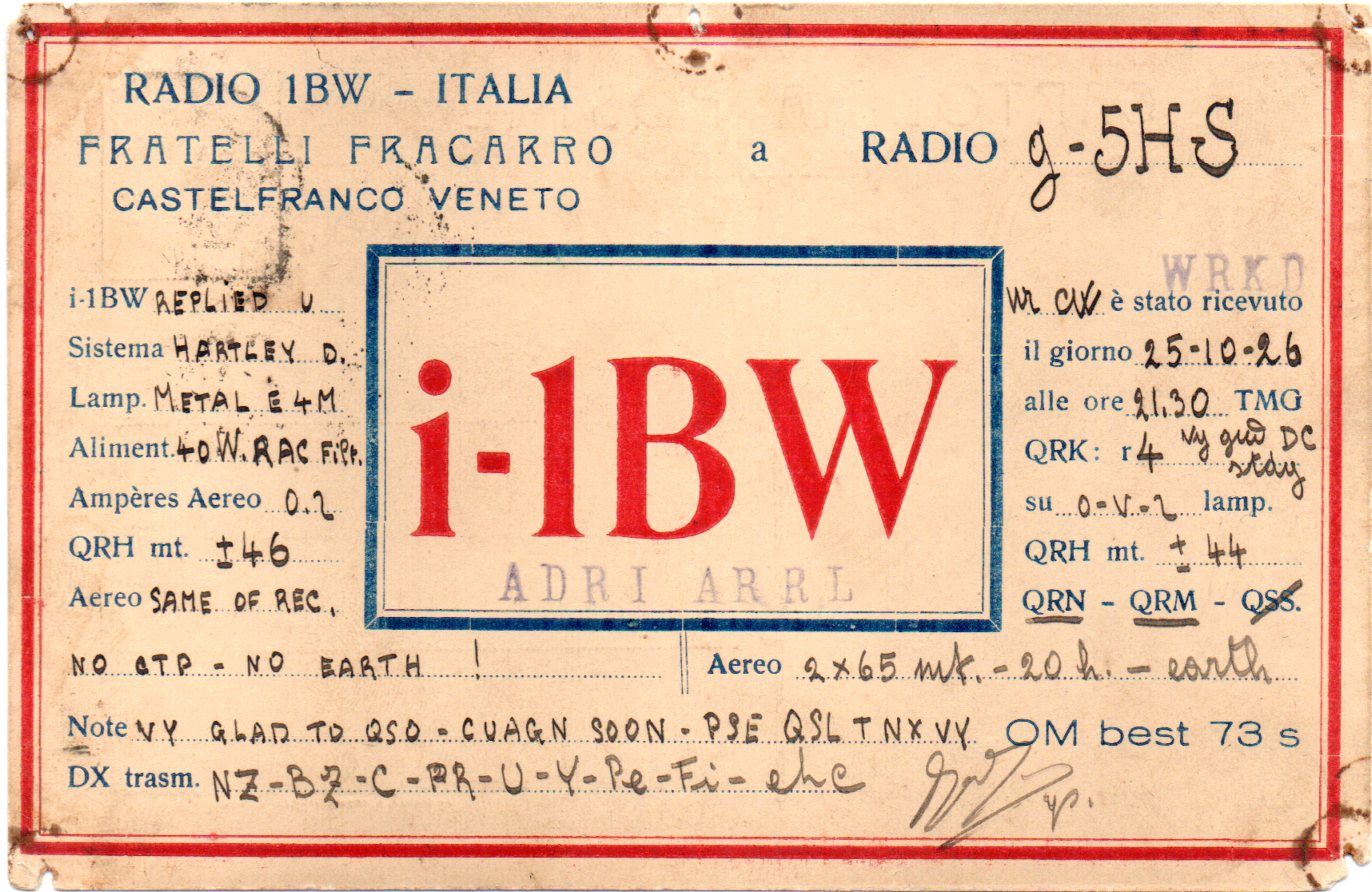
I1BW
- Operator
- Giovanni Fraccaro (Fratelli Fracarro)
- QSO Date
- 1926-10-25
- QSO Time
- 21:30 TMG
- Mode
- CW
- Band
- 40m
i1BW – Fratelli Fracarro, Castelfranco Veneto: The Amateur Station that Became Fracarro Radioindustrie
Introduction
The card is printed "Radio 1BW – Italia – Fratelli Fracarro – Castelfranco Veneto", and the firm that grew out of that station still makes antennas in the same town. The brothers Giovanni and Bruno Fraccaro (the family name; the company spelling "Fracarro" was adopted from 1929) began as listeners in December 1924, transmitted as 1GB from 12 September 1925, became 1BW on 23 November 1925 and, according to the company's own history, founded Fracarro Radioindustrie in 1933 from a business that in 1929 was still called "Radio 1BW". Il Radio Giornale names Giovanni as the operator.
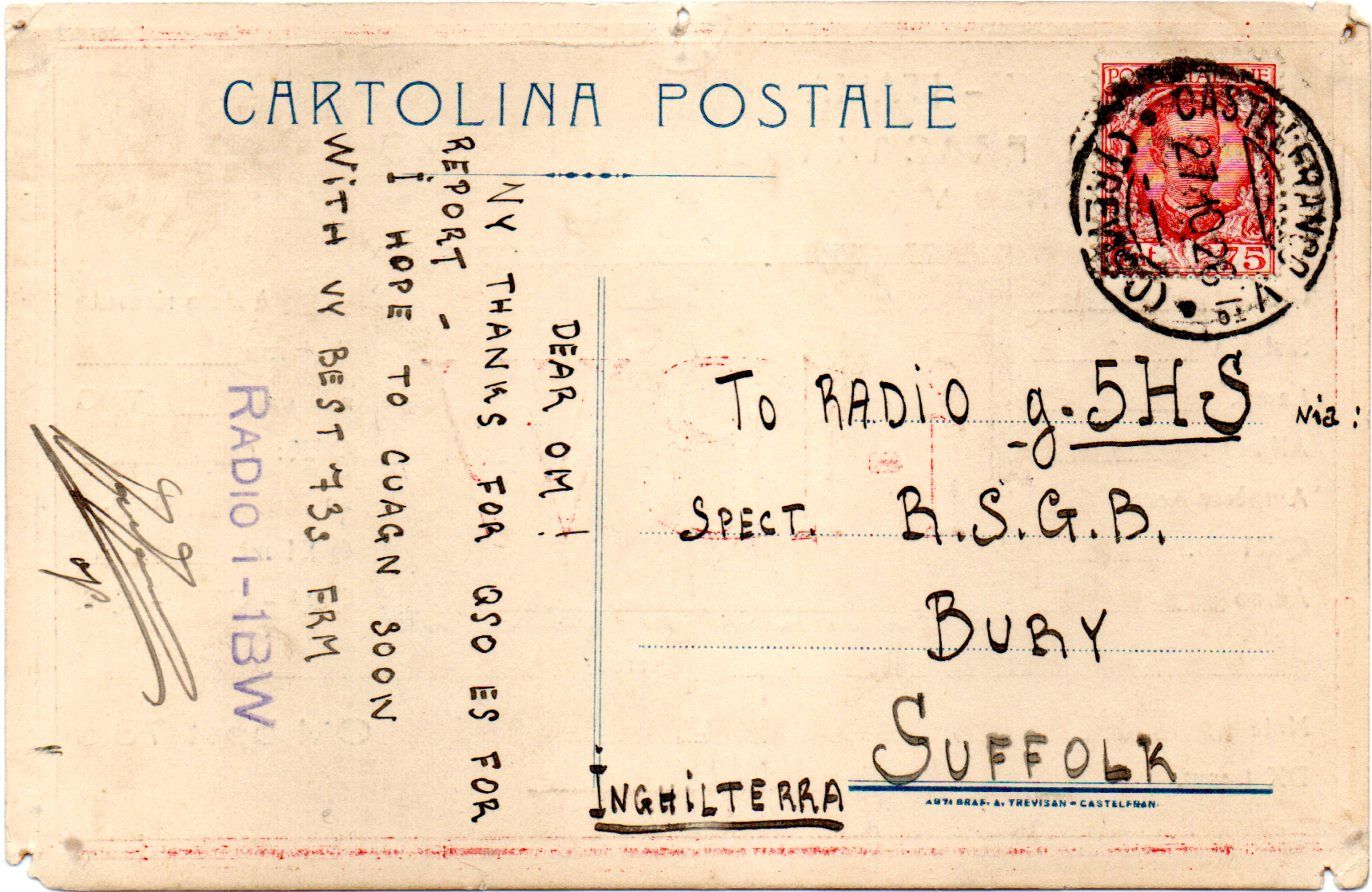
The card was written on 25 October 1926, two days before it was posted, for the British station g5HS and sent "Spect. R.S.G.B., Bury, Suffolk", the address of the R.S.G.B. QSL bureau of the time. It reports g5HS's CW received at 21:30 TMG at r4 "vy gud DC stdy" on 44 m, and gives i1BW's reply on 46 m.
From 1GB to 1BW (1924–1926)
"Sig. Giovanni Fracarro, Castelfranco Veneto, dal 5 al 23 Dicembre con antenna esterna aperiodica e ricevitore a 1 valvola" heads a reception list in January 1925; his log includes the Ferrara club station i1AA (see I1AA-1925-01). In October 1925 the magazine prints "F.lli Fracarro - Castelfranco Veneto (1GB) su Bourne+1BF; antenna bifilare … alta 20. Lunghezza d'onda 30 a 90 m." and Pirovano hears "1GB (r3)". The first DX followed at once: "i 1BW (Fracarro, Castelfranco Veneto) ha comunicato bilateralmente nel mese di novembre con pr 4SA, u3CEL, u2GP uNAH usando circa 50 Watt alimentazione" (December 1925). A letter of 4 January 1926, signed "Gio. Fracarro i1BW (ex i1GB)", explains the call change and the station's history: "Come Lei sa io ho usato il nominativo i1GB fino al 23 novembre 1925 … ho cominciato a trasmettere il 12 settembre 1925 … il mio 'best DX' è finora PR e USA", rejecting a New Zealand reception claimed for July 1925, before he was on the air. The same month 1CO reported telephony with i1BW on 75 m, and the February 1926 list is impressive for a 50-watt station: "Canadà: 2AX. Porto Rico: 4UR, 4JE. Stati Uniti: 1ALL, 1BVB, 1CMP, 1HJ, 1IH, 1ZS, 2JN, 2MK, 3AHL, 3BMS, 3HG, 4JR, 4UA, 8DOY, 8ES, 8ZAE. (Totale 19 bilaterali)." In 1926 1BW was heard by u9AKF and J. Scarlett in the United States, in India, Great Britain, Spain and Austria, and by u2AHK, u3QT, u2AER and u8CNX. The card's "DX trasm: NZ – BZ – C – PR – U – Y – Pe – Fi" (New Zealand, Brazil, Canada, Porto Rico, USA, Uruguay, Peru, Philippines) extends the list into the autumn of 1926.
The October 1927 list of Italian transmitters gives "1BW - Giovanni Fracarro, Castelfranco Veneto". The station's last appearance in the magazine is in July 1928, during the search for Nobile's airship Italia: "ei 1BW (Castelfranco Veneto) ci comunica: «La Città di Milano iGJ è stata ricevuta tutte le notti qui a Castelfranco con intensità r8-9 … il 18 giugno alle ore 02,45 … sono stati ricevuti benché molto deboli … i segnali della stazioncina di Biagi («Italia») sulla banchisa»"; "I fratelli Fracarro di Castelfranco Veneto hanno potuto percepire, per quanto debolmente, i segnali dell'apparecchio di fortuna dell'«Italia»". The call books of 1959–65 list Giovanni Fraccaro as I1FR and Bruno as I1ADB.
The card itself
- To: g5HS, via the R.S.G.B. bureau, Bury, Suffolk. 5HS, M. Samuel of London NW8 in the call books of the period, was an active DX station: the T. & R. Bulletin of August 1926 reports him working Java and Australia with 80 watts. "Ur CW è stato ricevuto il giorno 25-10-26 alle ore 21.30 TMG, QRK r4 vy gud DC stdy, su 0-V-2 lamp., QRH ±44 m."
- i1BW replied: "Sistema Hartley D., lamp. Metal E4M, aliment. 40 W RAC filt., ampères aereo 0.2, QRH ±46, aereo same of rec., no ctp – no earth!"; "Aereo 2 x 65 mt – 20 h – earth".
- Note: "Vy glad to QSO – cuagn soon – pse QSL tnx vy"; "DX trasm. NZ-BZ-C-PR-U-Y-Pe-Fi-etc"; printed ADRI ARRL.
- Back: "Dear OM! Vy thanks for QSO es for report. I hope to cuagn soon with vy best 73s frm Radio i-1BW" (stamp); postmarked Castelfranco Veneto 27.10.26; printed Arti Graf. A. Trevisan, Castelfranco.
Key Specifications of 1BW
| Component | Description |
|---|---|
| Location | Castelfranco Veneto (Treviso) |
| Operators | Giovanni Fraccaro (operator named by the magazine) and his brother Bruno; founders of Fracarro Radioindustrie (1933) |
| Power | About 50 W (1925); 40 W rectified and filtered AC (card) |
| Wavelengths | 44–46 m (card); 75 m telephony (Jan 1926); receiving 30–90 m |
| Antenna | Two wires of 65 m, 20 m high, earth, no counterpoise |
| Equipment | Hartley with Métal E4M; Bourne + 1 BF (1925), 0-V-2 (card) |
| Achievements | Porto Rico and USA with 50 W in the third month of operation (Nov 1925); 19 transatlantic contacts in February 1926; Peru, Philippines, New Zealand by late 1926; heard Biagi's Italia transmitter from the ice (18 June 1928) |
Sources
- Il Radio Giornale, January 1925, p. 21; October 1925, p. 16; November and December 1925 (p. 13); January 1926, pp. 15, 17–18 (letter of 4 January 1926); February, March (p. 15), April, June, July, September, October, November and December 1926 (reception lists); May, July, October (list of transmitters) and November 1927; July 1928, pp. 13–14 (Italia signals); scans at introni.it.
- R.S.G.B., T. & R. Bulletin, August 1926 (5HS) and November 1926 (bureau address "T. & R. R.S.G.B., Bury, Suffolk"); Jack Hum's list of British calls 1920–34 (5HS, M. Samuel, London NW8).
- Fracarro, "La storia" (fracarro.com); Museo Fracarro, "Fracarro / Fraccaro"; Radio Amateur Call Book, Spring 1959, Winter 1962 and Summer 1965 (I1FR Giovanni Fraccaro, I1ADB Bruno Fraccaro, Castelfranco Veneto).
- The card itself (front and back), K1FM collection.