Card images
I1AA
- Operator
- Società Ferrarese Amici delle Radiocomunicazioni
- QSO Date
- 1925-07-07
- QSO Time
- 22:45 TMG
- Mode
- CW
- Band
- 80m
i1AA – Società Ferrarese "Amici delle Radiocomunicazioni", Ferrara: A Club Station of 1925
Introduction
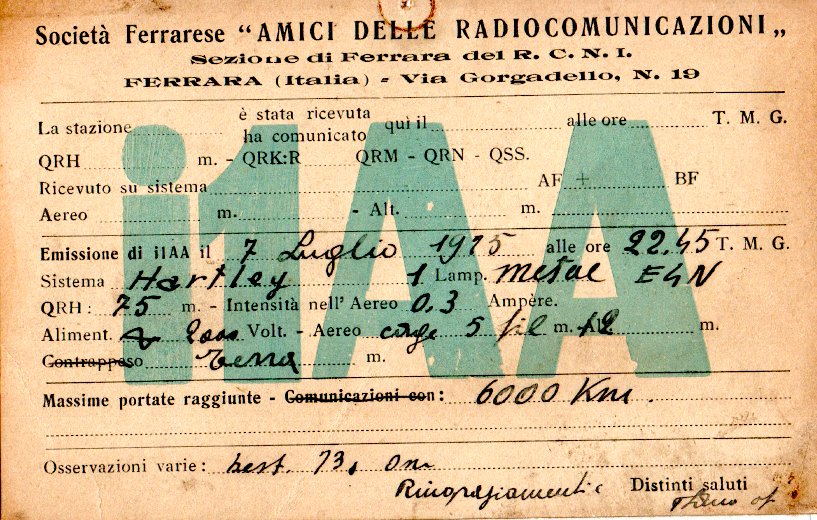
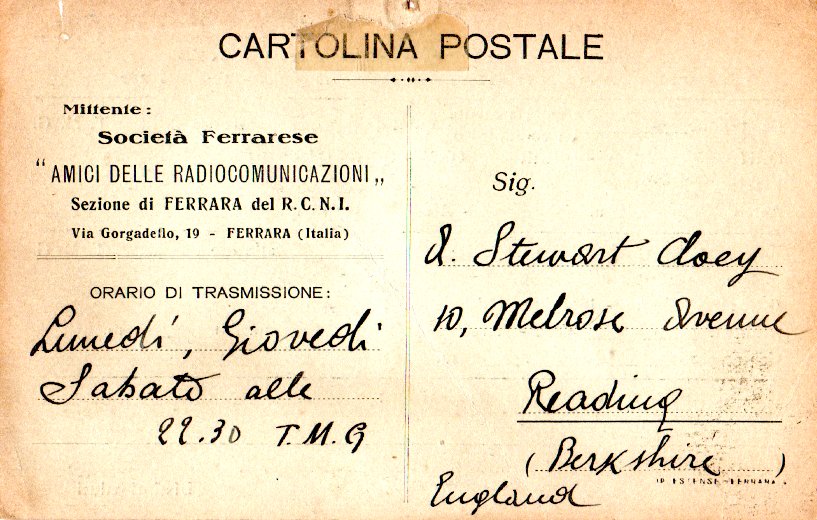
The sender of this card was a society, not a person: the Società Ferrarese "Amici delle Radiocomunicazioni", Ferrara section of the Radio Club Nazionale Italiano, Via Gorgadello 19. The card confirms an "emissione di i1AA" on 7 July 1925 at 22:45 TMG and was posted to a British listener, D. Stewart Doey, 10 Melrose Avenue, Reading. Its back prints the society's transmitting schedule: "Lunedì, Giovedì, Sabato alle 22.30 T.M.G.".
The society
Il Radio Giornale of February 1924 (pages 24–25) announced "la recente fondazione della S.F.A.R. (Società Ferrarese Amici delle Radiocomunicazioni) che ha sede in Via Gorgadello, 19. La Società, che conta già 50 soci…" and printed its statute: "approvato dall'Assemblea di fondazione, il giorno 9 dicembre 1923. Art. 1. – È costituita la Società Ferrarese «Amici delle Radiocomunicazioni» con decorrenza 9 Dicembre 1923." By December 1924 it had 150 members and was represented at the R.C.N.I. assembly by "Ing. Leonello Boni, presidente; Ing. Mario Chiozzi, vice presidente; Ing. Pietro Lana, segretario tecnico; Ing. Enrico Raimondi, segretario amministrativo". In May 1924 Ing. Boni, "presidente del Radio Club di Ferrara", was Italy's delegate at the Geneva conference on radio and Esperanto. The assembly of 9 January 1926 elected Prof. Cav. Silvio Magrini president, with Chiozzi, Lana, Sinz, Cuccati, Santini, Casoni and Ferrari. The society's officers were themselves amateurs: Boni was 1AO, Lana 1BU and Orfeo Santini 1BF in the October 1927 list, which still carries "1AA – Soc. Amici di Radiocomunicazioni, Via Gorgadello n. 19, Ferrara". From 1927 Boni, and from June 1928 Lana, was the A.R.I. delegate for the province of Ferrara. The present-day ARI section of Ferrara, which traces its origin to the society, states that the station was built and operated by Pietro Lana with Boni and Chiozzi and transmitted from the north-west tower of the Castello Estense; the magazine does not mention the castle.
The station on the air
From October 1924 the society sent the magazine monthly lists of stations heard, with its receiving equipment: "1AF – 1Det – 1BF aereo bifilare 60 m" (November 1924), an autodyne with two audio stages (December 1924), "Ricev. Bourne, 1 A.F. 1 B.F. – Aereo unifil. 25 m" (May 1925, hearing i3AM, i1RT, i1AF, i1WB and i3MB). The earliest trace of the transmitter is in the December 1924 log of Giovanni Fracarro of Castelfranco Veneto (see I1BW-1926-01), who heard "i1AA" on 17 and 19 December 1924. In June 1925 the magazine printed the station's first list of two-way contacts: "Comunicazioni bilaterali eseguite dalla stazione i1AA, della Società Ferrarese «Amici delle Radiocomunicazioni» nel mese di maggio 1925. Italia (i): 1CM – 1AY – 1AS – 1WA – 3AR. Francia (f): 8SSX – 8KL. Inghilterra (g): 6GM. Portogallo (p): B2." The British g6PG and a Rotterdam listener ("1AA (r6)", July 1925) heard it, as did Everett at Felsted (R5, September 1925) and Pirovano at Como (R6, October 1925); the card's "massime portate raggiunte 6000 km" would correspond to a transatlantic reception. The card's own data, a Hartley with one Métal E4N valve at 2,000 V, 0.3 A in a five-wire cage aerial on 75 m, are the only description of the transmitter.
One later notice should be recorded: in January 1928 (page 28) the magazine wrote that "la stazione 1AA del Radio Club Ferrara, malgrado sia inattiva dal marzo 1925 continua a ricevere qsl. Ciò prova che qualche dilettante fa uso abusivo del suo nominativo." The May 1925 contact list and this card of July 1925 show that the date is wrong, or that the society's own records differed; the station was certainly inactive by 1927. The claim sometimes made that i1AA was "the first officially recognised Italian amateur station" is the Ferrara section's own; the magazine's station list of February 1924 already contained 1MT, 1GNS and 1RCL.
The card itself
- Printed: "Società Ferrarese «Amici delle Radiocomunicazioni» – Sezione di Ferrara del R.C.N.I. – Ferrara (Italia) – Via Gorgadello, N. 19", with a two-part form: the correspondent's station (left blank) and "Emissione di i1AA".
- Emission: 7 luglio 1925 alle ore 22.45 T.M.G.; sistema Hartley, 1 lamp. Métal E4N; QRH 75 m; intensità nell'aereo 0.3 A; aliment. 2,000 volt; aereo cage 5 fili, m 12; terra; "Massime portate raggiunte: 6000 km"; "best 73s OM"; "Ringraziamenti. Distinti saluti".
- Back: "Mittente: Società Ferrarese … Orario di trasmissione: Lunedì, Giovedì, Sabato alle 22.30 T.M.G."; addressed to Sig. D. Stewart Doey, 10 Melrose Avenue, Reading (Berkshire), England; printed Tip. Estense, Ferrara.
Key Specifications of i1AA
| Component | Description |
|---|---|
| Location | Via Gorgadello 19, Ferrara (the section's seat); the ARI Ferrara tradition places the transmitter in the Castello Estense |
| Operators | Members of the Società Ferrarese "Amici delle Radiocomunicazioni" (founded 9 December 1923): Ing. Leonello Boni (1AO), Ing. Pietro Lana (1BU), Ing. Mario Chiozzi and others |
| Power | 2,000 V, 0.3 A aerial current |
| Wavelengths | 75 m |
| Antenna | 5-wire cage, 12 m; earth |
| Equipment | Hartley with one Métal E4N; Bourne receiver with AF and BF stages, 25–60 m aerials (1924–25) |
| Achievements | Heard from December 1924; contacts with Italy, France, England and Portugal (May 1925); heard in the Netherlands and England (1925); claimed range 6,000 km |
Sources
- Il Radio Giornale, January and February 1924 (pp. 24–25, foundation and statute), May 1924 (Geneva conference), October, November and December 1924 (reception lists; R.C.N.I. assembly), January 1925 (Fracarro's log), March, April, May, June, July, September, October and November 1925 (reception lists and contacts), February 1926 (assembly of 9 January 1926); scans at introni.it.
- Il Radio Giornale, January 1927 – June 1928 (A.R.I. delegates for Ferrara), October 1927 (list of transmitters), January 1928, p. 28 (notice on 1AA); scans at introni.it.
- ARI Ferrara, "La nostra storia" (ari-ferrara.it).
- The card itself (front and back), K1FM collection.