Card images
EI1GC
- Operator
- Gian Giacomo Caccia
- QSO Date
- 1928-10-02
- Mode
- CW
- Band
- 40m
ei1GC – Gian Giacomo Caccia, Villaggio dei Giornalisti, Milan: Low-Power Telephony and a Portable Transmitter in a Suitcase
Introduction
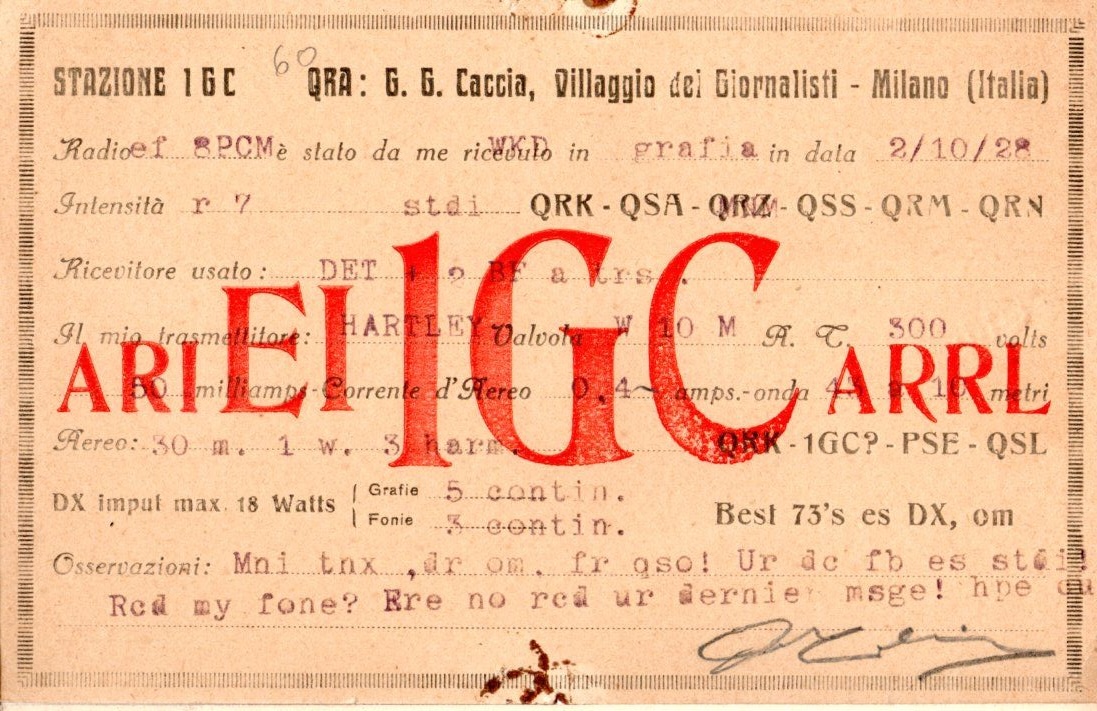
"Stazione 1GC, QRA: G. G. Caccia, Villaggio dei Giornalisti - Milano": the sender of this card lived in the garden suburb built from 1911 for Milan's journalists, today the Maggiolina quarter. Il Radio Giornale of October 1927 gives his full name, "1GC - Gian Giacomo Caccia, Villaggio Giornalisti, Milano". The card confirms a telegraphy contact with the French station ef8PCM on 2 October 1928, received at r7 and steady, and ends with a question that sums up the station's interests: "Rcd my fone?"
Twenty watts on 40 metres (1927–1928)
1GC entered the magazine's activity column in December 1927: "ei1GC trasmette tutte le sere grafia alle 21,30 e 2300 ora italiana; alimentazione 20 watts QRH 40 m. circa. Pse qsl via A.R.I." By March 1928 he was on telephony every day ("ei 1GC trasmette fonia su 41 m. alle ore 13 e alle ore 21,30 di tutti i giorni"; listeners reported "1GC: r8, modulazione non costante"), adding 33 m in April. His monthly reports give a clear picture of what 15–18 watts into a Telefunken W10M triode could do in 1928:
- April 1928: "Bilaterali eseguite nel mese d'Aprile. (Triodo W10M normale, 15-18 alim.) Europa: 43 stazioni; Stati Uniti: 4AFE, Cuba: 5CX. Con alcune stazioni fu provata la fonia con ottimi risultati."
- May 1928: "ei 1GC (alim. watt 15 - Tr. W 10 M normale) nel mese di maggio ha comunicato in fonia con quasi tutte le nazioni europee ed inoltre con stazioni dell'Algeria e del Marocco." Heard by ear94 in Barcelona and by oz2GO in Wellington, New Zealand.
- June 1928: telegraphy with almost every European country, Algeria and North America; telephony with Belgian, French, British, Spanish and Algerian stations; "ear94 (Barcellona): ottima, r7 (con ei1GC)".
- August 1928: telephony with the usual Europeans, with the United States and with 2PA in Jamaica.
- September 1928: "ha comunicato in grafia con cinque continenti. In fonia ha comunicato col Marocco, cogli Stati Uniti d'America e con quasi tutte le nazioni europee."
The card's "DX input max 18 Watts: grafia 5 contin., fonie 3 contin." is thus an exact summary of the September 1928 report, and its "W10M" valve, 300 volts, 50 mA and 43 m match the magazine. In the 1928 A.R.I. telephony contest 1GC scored every month from March to October (2 points a month, 3 in September). The lists printed from January 1928 that show him as number 5 or 6 are the enrolment lists of the 1928 contests, in order of registration, not placings; the final classification was published in 1929.
The suitcase transmitter (Turin, October 1928)
At the second A.R.I. congress in Turin, in October 1928, Caccia demonstrated a portable station for the A.R.I. 1928 portable-transmitter contest: a demonstration over 25 km "con un trasmettitore portabile a onda corta installato su automobile con aereo a telaio di 50 per 50 cm., presentato dal signor G. G. Caccia", received at the Royal Navy station. He described it in December 1928 (pages 7–8) in "Il trasmettitore trasportabile xei 1GC", signed "G. G. Caccia - 1GC": a Hartley with a Telefunken RE 134, 200 V of dry batteries, 40 mA, 8 W input, a 48 cm loop aerial, 39–63 m, in a case of 50 x 25 x 20 cm weighing 18 kg. The results at Turin were "distanza 200 m. grafia r9 fonia r5 … 5 Km grafia r7 … 20 Km grafia r2", the receiving end being manned by Franco Marietti, 1NO.
The card itself
- To: ef8PCM, "wkd in grafia in data 2/10/28", intensity r7 steady. The French station could not be identified in the 1928 call book.
- Receiver: detector + 2 BF (transformer-coupled).
- Transmitter: Hartley, W10M valve, 300 volts, 50 mA, aerial current 0.4 A, 43 m; aerial 30 m, one wire, worked on its third harmonic; DX input max 18 watts, telegraphy five continents, telephony three continents.
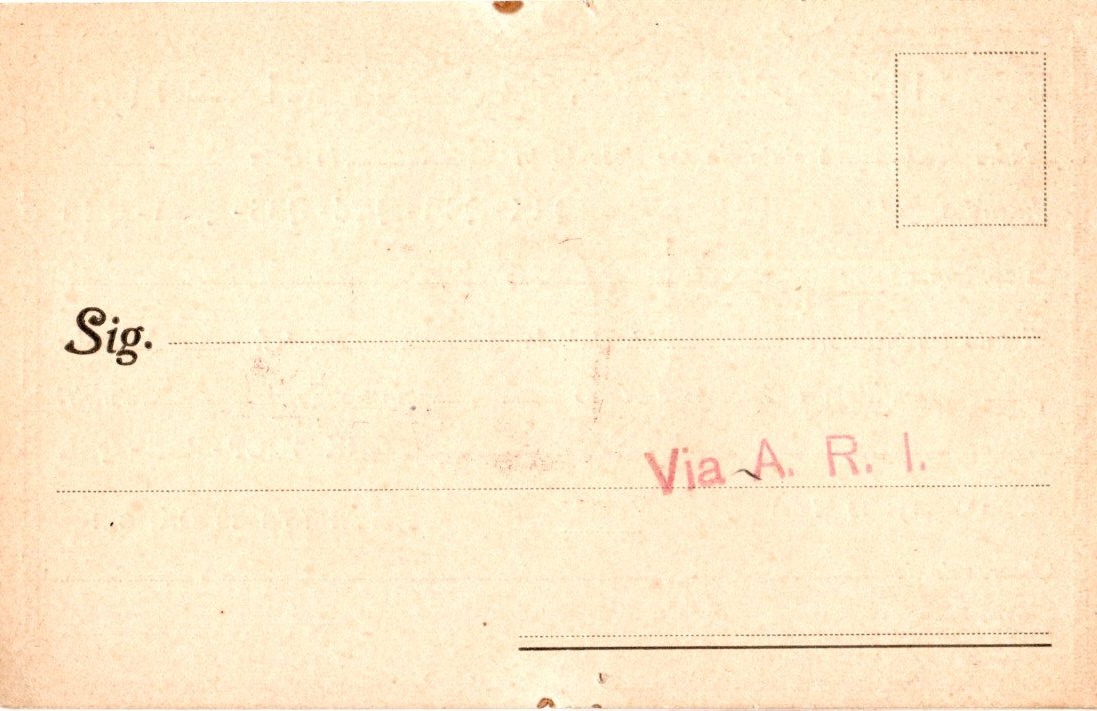
- Remarks: "Mni tnx dr OM fr QSO! Ur DC fb es stdi. Rcd my fone? Ere no rcd ur dernier msge! hpe cuagn"; printed ARI – ARRL; "Via A.R.I." on the back.
Whether this Gian Giacomo Caccia is the "dott. Caccia" who, according to Paoletti's chronology, assisted G. Pluda (1CS) in Milan's first short-wave television experiments in July 1928, or the G. G. Caccia who later wrote on receivers and transistors, could not be established.
Key Specifications of 1GC
| Component | Description |
|---|---|
| Location | Villaggio dei Giornalisti (Maggiolina), Milan |
| Operator | Gian Giacomo Caccia |
| Power | 20 W (1927); 15–18 W (1928); 8 W portable |
| Wavelengths | 40–43 m, 33 m; portable 39–63 m |
| Antenna | 30 m single wire on its third harmonic; 48 cm loop (portable) |
| Equipment | Hartley with Telefunken W10M, 300 V; portable Hartley with RE 134; det + 2 BF receiver |
| Achievements | Five continents on CW and three on telephony with 18 W (1928); monthly points in the A.R.I. 1928 telephony contest; portable transmitter demonstrated at the Turin congress (1928) |
Sources
- Il Radio Giornale, October 1927 (list of Italian transmitters), December 1927, March, April, May, June, July, August, September, October, November and December 1928 ("Le vie dello spazio" reports, contest tables, Turin congress); December 1928, pp. 7–8 ("Il trasmettitore trasportabile xei 1GC"); scans at introni.it.
- Federico Paoletti, Storia della radiodiffusione in Italia (federicopaoletti.it), entry for 12 July 1928.
- On the Villaggio dei Giornalisti: Dils, "The history of Milan's Maggiolina district"; Le Petit Journal, "Découverte de la Maggiolina, le village des journalistes de Milan".
- The card itself (front and back), K1FM collection.