Card images
EI1FP
- Operator
- Franco Pugliese
- QSO Date
- 1928-04-13
- QSO Time
- 00:45
ei1FP – Franco Pugliese, Milan: Vice-Secretary of the A.R.I., Radio Operator of the Perla Cruise, Builder of the Station that Heard the Italia
Introduction
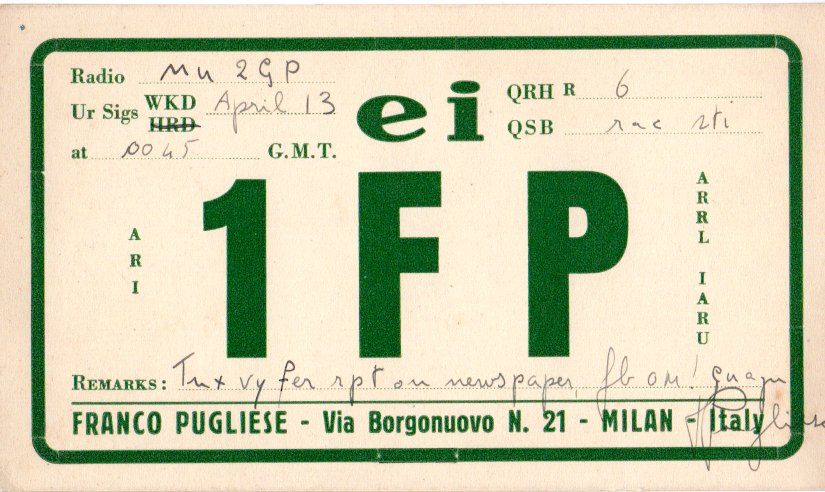
The address printed on this card, Via Borgonuovo 21, Milan, was the seat of the A.D.R.I. and then of the A.R.I., and its owner, Franco Pugliese (also recorded as Pugliese-Levi), was the association's vice-secretary general from its foundation on 1 January 1927. The card, sent through the A.R.I. and A.R.R.L. bureaux to nu2GP, Donald C. Sayer of Richmond Hill, New York, confirms a contact of 13 April at 00:45 GMT, with the remark "Tnx vy fer rpt on newspaper, fb OM! cuagn". The year is not written; the "nu" prefix and the Via Borgonuovo card place it in 1928.
A founding officer of the A.R.I.
Pugliese was already on the air in 1926: Il Radio Giornale of August and September 1926 mentions skip-zone experiments on 34 m "fra 1SS, 1FP, 1BO, 1GN", and in November 1926 the American u1AYG lists "1AS, 1BK, 1FP, 1GW, 1NO" among the Italians heard. Federico Paoletti's chronology dates his short-wave activity from November 1924 and names him among the operators of "Radio Posto Zero" in May 1925.
The January 1927 issue prints the first A.R.I. board: president Giuseppe Pession, vice-presidents Gnesutta and Marietti, secretary general Monti, "Vice Segretario generale: Franco Pugliese". From then on he signs council minutes, sits on the commissions sent to the ministries in Rome (February 1927), on the commission preparing the Como congress (with Gnesutta, Pagliari and Pirovano), and, from 1 December 1927, runs the A.R.I. QSL service ("col 1 dicembre 1927 il servizio qsl viene affidato al vice-segretario sig. Pugliese"). In February 1928 he was elected one of the three auditors, and in June 1928 he sat with Gnesutta and Montù on the commission that classified the 1927 national contest. In November 1928 he received the diploma of "Stazione distinta" and stood for the council.
The Perla cruise (1927)
In April 1927 the magazine announced that Pugliese would sail on the motor ship Perla for a circumnavigation of Africa, "incaricato dalla spedizione e dal Ministro delle Comunicazioni di mantenere contatto radiotelegrafico tra la nave e l'Italia". The station, "espressamente costruita dal signor Pugliese", comprised a transmitter with two Marconi T250 valves, a 10-watt portable transmitter and a portable Bourne receiver. The May 1927 issue shows a photograph of "Salom (1MT), Sandri (1SS) e Pugliese (1FP) sulla nave «Perla»" and gives the ship's schedule: "XEI1FP trasmette alle 2230 gmt su 41 m." He returned in November 1927.
1928: the A.R.R.L. contest, the Italia and the "newspaper"
In July 1928 (pages 7–8) Pugliese published "L'apparecchio di soccorso del dirigibile «Italia» e i dilettanti", signed "Franco Pugliese - ei 1FP": a defence of amateur-style portable equipment prompted by Giuseppe Biagi's small emergency transmitter, in which he describes a portable set he had built in 1926 with Gnesutta (0-V-1 receiver, 40 m transmitter with a Telefunken RE 209 fed from a vibrator at 300 V) and taken on a cruise to Tripoli, working ei1GN in Milan and American stations with no more than 6 watts.
His December 1928 article "Il nuovo trasmettitore sperimentale" (pages 9–15) describes the station behind this card: "Una stazione venne da noi costruita … con essa fu vinto nel febbraio scorso il primo premio per l'Italia nel Concorso Internazionale indetto dalla A.R.R.L.", a Colpitts with a Marconi T250, AC-heated filament, 1,000 V from a dynamo, 90 W input, bands of 50, 30, 21 and 13 m and a 37.5 m aerial. "Su 20 metri abbiamo comunicato ogni sera per due mesi con la spedizione polare di Mac Millan (WNP) … mentre Biagi, di ritorno in Italia ci fece sapere che ci ricevette spesso con ottima intensità sia nell'ultimo volo dell'«Italia» sul Polo, come durante i giorni tragici della «Tenda Rossa»." The contact confirmed by this card, in April 1928, falls in the weeks between the A.R.R.L. International Relay Contest of February 1928 and the loss of the Italia on 25 May; the "report on newspaper" that Pugliese thanks Sayer for was presumably a press notice of ei1FP's signals in the United States. The magazine's reception lists of early 1928 record him heard by nu8CRG of Amherst, Ohio, by nu1BUX of Touisset, Massachusetts, in Lwów, Sweden and Estonia, and, in telephony, "mediocre, r4, rauca" on 9 February 1928.
The card itself
- To: nu2GP, D. C. Sayer, 11407 St. Anns Ave., Richmond Hill, N.Y. "Ur sigs wkd April 13 at 0045 GMT", QRH R6, QSB "rac sti" (rectified AC, steady).
- Remarks: "Tnx vy fer rpt on newspaper, fb OM! cuagn", signed Pugliese.
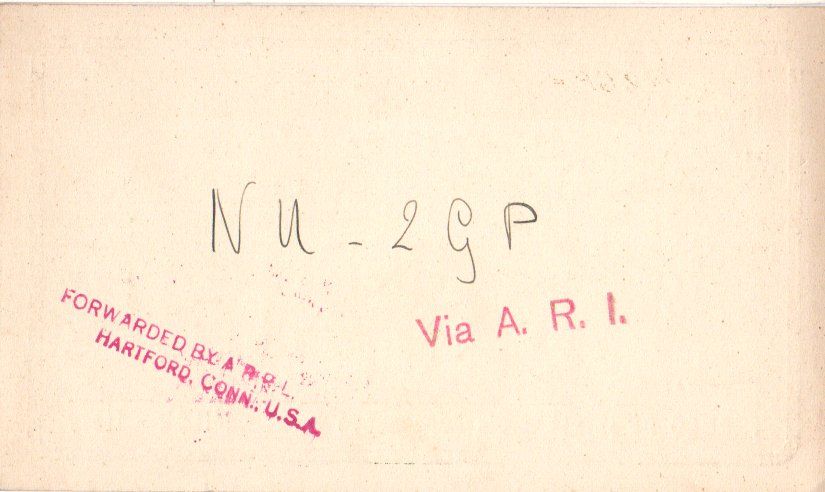
- Printed A.R.I. / A.R.R.L. I.A.R.U., "Franco Pugliese - Via Borgonuovo N. 21 - Milan - Italy"; "Via A.R.I." and "Forwarded by A.R.R.L., Hartford" on the back.
Key Specifications of 1FP
| Component | Description |
|---|---|
| Location | Via Borgonuovo 21, Milan (seat of the A.D.R.I. and A.R.I.) |
| Operator | Franco Pugliese (Pugliese-Levi); A.R.I. vice-secretary general (1927–28), head of the QSL service (Dec 1927), auditor (1928) |
| Licence | Listed October 1927, expiring 3 August 1928 |
| Power | 90 W input (1928 transmitter); 10 W portable (1927); 6 W portable (1926) |
| Wavelengths | 41 m (Perla, 1927); 50, 30, 21 and 13 m (1928) |
| Antenna | 37.5 m wire (1928) |
| Equipment | Colpitts with Marconi T250, 1,000 V dynamo (1928); Bourne portable receiver (1927) |
| Achievements | Ship-to-shore amateur link on the Perla African cruise (1927); first prize for Italy in the A.R.R.L. International Relay Contest, February 1928; nightly 20 m contacts with the MacMillan Arctic expedition (WNP); heard by Biagi during the Italia flight and from the "Red Tent" (1928) |
Sources
- Il Radio Giornale, August, September and November 1926 (1FP experiments and reception); January, February, April, May, October and December 1927 (A.R.I. board, missions to Rome, Perla cruise, licence and QRA lists, QSL service); January, February, April, May, June, September and November 1928 (auditors, reception lists, contest commission, congress committee, "Stazione distinta"); July 1928, pp. 7–8 ("L'apparecchio di soccorso del dirigibile «Italia» e i dilettanti"); December 1928, pp. 9–15 ("Il nuovo trasmettitore sperimentale"); scans at introni.it.
- Federico Paoletti, Storia della radiodiffusione in Italia (federicopaoletti.it), entries for November 1924 and 5 May 1925.
- Radio Amateur Call Book, September 1928: 2GP, D. C. Sayer, Richmond Hill, N.Y.
- The card itself (front and back), K1FM collection.