Card images
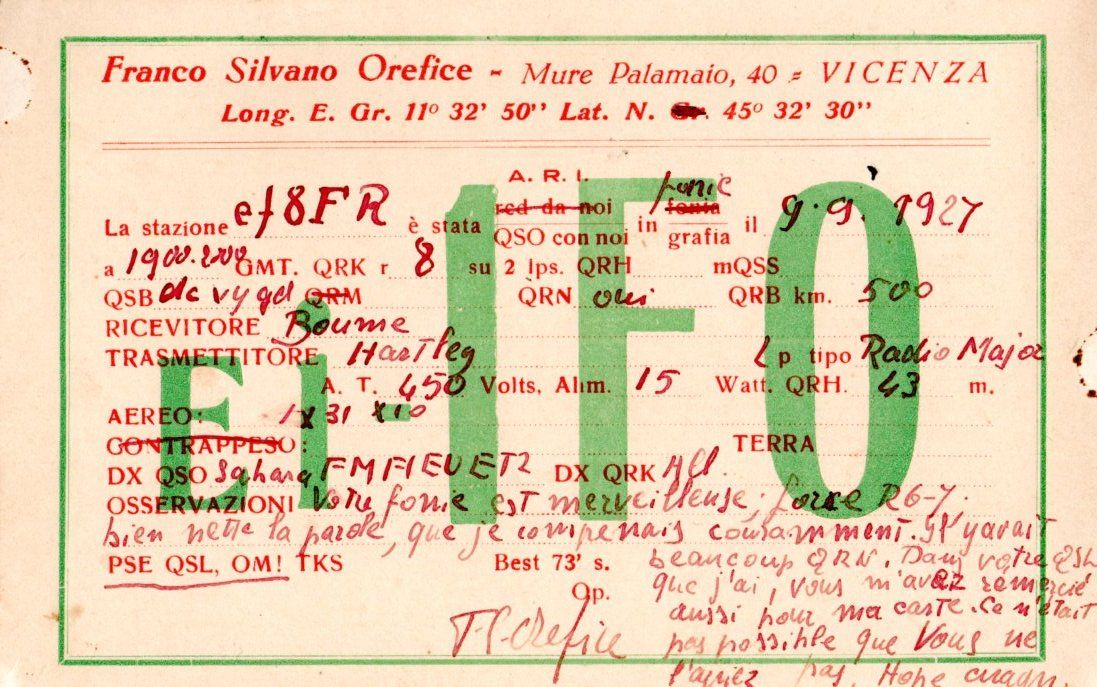

EI1FO
- Operator
- Franco Silvano Orefice
- QSO Date
- 1927-09-09
- QSO Time
- 19:00-20:00 GMT
- Mode
- Phone
- Band
- 40m
ei1FO – Franco Silvano Orefice, Vicenza: A Telephony Report to France, September 1927
Introduction
This card is not a QSL for a two-way contact but a listener's report of the kind that Italian amateurs exchanged with their French neighbours in the telephony boom of 1927. Franco Silvano Orefice, of Mure Palamaio 40 in Vicenza, printed his coordinates on the card (45° 32' 30" N, 11° 32' 50" E) and used it, on 9 September 1927, to tell the French station ef8FR that its telephony had been heard in Vicenza between 19:00 and 20:00 GMT at R8, with much atmospheric noise and a path of about 500 km. His remarks, in French, are enthusiastic: "Votre fonie est merveilleuse; force R6-7, bien nette la parole, que je comprenais couramment. Il y avait beaucoup de QRN." He adds that in the QSL he already holds from 8FR the Frenchman had thanked him for his card, so "ce n'était pas possible que vous ne l'ayiez pas", and closes "Hope cuagn".
The addressee was a frequent correspondent of the Italians: the 1CY card in this collection, from Rome, is also addressed to ef8FR, for a contact of 10 August 1927. The September 1928 Radio Amateur Call Book lists 8FR as Robert Dubs, 16 rue Richenstein, Mulhouse.
1FO in Il Radio Giornale
Orefice's station is first mentioned in March 1927 (page 34), in the February report of Federico Strada's 3-watt portable 1UA in Turin, under the telephony contacts: "EI1FO (Vicenza - Congratulazioni om! Risponda pure in fonia)", which shows that 1FO was already a phone station in the winter of 1926–27. From June 1927 onwards the call appears in almost every monthly list of Italian stations heard abroad: in France ("1FO, 1UU, 1IN, 1AO, 1MV, 1BD, 1GN (fonia)…"), in Spain by eaMM, eaKL and ear40 of Barcelona, in Germany by de0066 of Nuremberg, in Moscow by euRK16, in Oran by fm8JO, and by a long series of French listeners (ef8RCM in the Ardennes, ef8RVR, ef8LGB, ef8RVL at Laval, ef8RLL in Paris, ef8LIR, R167 at Reims, ef8JCB at Rennes). In December 1927 he was logged in New York, in Essex, in Spain, in Coburg and in Egypt ("1FO, 1DY (fonia)"), and in 1928 in Berlin, Bremen, Lwów, Dieppe, Lyon, Kassel, Hanover, Sanlúcar and, in June 1928, in Wellington, New Zealand, by oz2GO (Harold G. Fownes).
The October 1927 list of Italian transmitters gives "1FO - Franco Silvano Orefice - Muro Palamaio, 40, Vicenza" (the card prints "Mure"). He was not among the first licensees of 1927 and never entered the A.R.I. contests; the A.R.I. delegate for Vicenza was Giulio Baglioni (1GB). At the first A.R.I. congress in Como, in September 1927, the humorous report notes that "gli innumerevoli C.Q. di 1FO, di 1AU, di 1MA, ecc. in D.C. più o meno puro… hanno deliziato i congressisti". The last trace is personal: in November 1928 (page 37) the magazine announces "ei1FO partecipa a tutti gli OM la propria laurea. Rallegramenti." Orefice had just graduated.
The card itself
- To: ef8FR (Robert Dubs, Mulhouse, per the 1928 call book), received in telephony on 9.9.1927 at 1900–2000 GMT, QRK r8, QSB vy gd, QRN "oui", QRB 500 km.
- Receiver: Bourne.
- Transmitter: Hartley with a "Radio Major" valve, 450 volts on the plate, 15 watts, QRH 43 m; aerial 1 x 31 x 10 (one wire, 31 m long, 10 m high).
- DX QSO: the Sahara, French Morocco and a French military station (the line reads "Sahara FM…").
- Printed A.R.I.; the back is blank apart from a faint machine cancellation.
The "Radio Major" valve could not be identified; it is not mentioned in the magazine.
Key Specifications of 1FO
| Component | Description |
|---|---|
| Location | Mure (Muro) Palamaio 40, Vicenza; 45° 32' 30" N, 11° 32' 50" E |
| Operator | Franco Silvano Orefice (graduated 1928) |
| Power | 15 W, 450 V |
| Wavelengths | 43 m |
| Antenna | Single wire 31 m, 10 m high |
| Equipment | Hartley transmitter, "Radio Major" valve; Bourne receiver |
| Achievements | Telephony contacts from early 1927; heard throughout Europe, in Egypt, Algeria, Moscow and New Zealand (1927–28) |
Sources
- Il Radio Giornale, March 1927, p. 34 (1UA report mentioning EI1FO in telephony); June–November 1927, December 1927 and January–June 1928 (lists of Italian stations heard abroad); October 1927 (list of Italian transmitters; Como congress); November 1928, p. 37 (graduation notice); scans at introni.it.
- Radio Amateur Call Book, September 1928, French section: 8FR, Robert Dubs, Mulhouse.
- The card itself (front and back), K1FM collection.