Card images
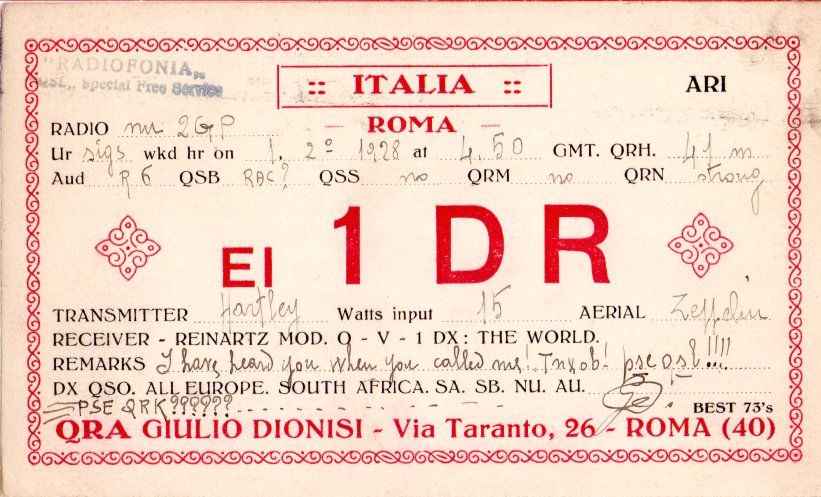
EI1DR
- Operator
- Giulio Dionisi
- QSO Date
- 1928-02-01
- QSO Time
- 04:50 GMT
- Mode
- Phone
- Band
- 40m
ei1DR – Giulio Dionisi, Rome: One of the First Nine Licensed Italian Amateurs
Introduction
Giulio Dionisi's name appears in Il Radio Giornale of September 1927 in a short but historic list: "Hanno già ricevuto la licenza di trasmissione i signori: Salom Giulio, Volterra Ezio, Strada Federico, Dionisi Giulio, Sandri Silvio, Caselli Antonio, Pirovano Enrico, Martini Umberto, Ramazzotti Giuseppe", the first official amateur transmitting licences issued in Italy. The October 1927 table gives "1DR Dionisi Giulio - Roma", licence expiring 26 July 1928, and the list of Italian transmitters "1DR - Giulio Dionisi, Via Taranto 26, Roma (40)", exactly the address printed on this card.
The card confirms a contact with nu2GP, Donald C. Sayer of Richmond Hill, New York, on 1 February 1928 at 04:50 GMT on 41 metres, received R6 with strong atmospherics, and adds, in the remarks, "I have heard you when you called me! Tnx OB! pse QSL!!!" It carries the stamp of the Radiofonia QSL service of Rome as well as the A.R.I. initials.
1DR on the air, 1927–1928
The station is first listed in May 1927 among the Italians heard in France, Spain and Great Britain. Through the summer and autumn of 1927 it is one of the most frequently reported Italian signals: by listeners in France (ear61 of Barcelona, R167, R221 at Toulouse, R367 at Poitiers), Germany (Berlin, Frankfurt, Königsberg, Munich, Göttingen), Sweden, Spain (Palma, Reus), Moscow and Lwów, and, in July 1927, by three Australians ("da eaMP: 1WW, 1DI, 1DO, 1PN, 1DR"; "da eaMM: 1CR, 1WW, 1FO, 1DR, 1FC"; "da eaKE: 1DI, 1DR, 1UN"). By Christmas 1927 he was using telephony: a listener at Udine logged "ei1DR, fonia r6, qrh 43, 25/XII", another "ei1DR, fonia r3, buona, 25/XII" (January 1928). In March 1928 a Varese listener reported "ei1DR: buona, r7"; reception lists of the spring of 1928 add Sanlúcar, Västerås, Reims, Uppsala, Göttingen, Berlin, Barmen and Estonia.
Dionisi entered the third A.R.I. contest of 1928, for portable transmitters; the list of its six entrants printed from June to September 1928 ends "6) Giulio Dionisi (1DR), Roma", an enrolment number, not a placing. In the monthly tables he scored a point in the telephony contest in June, August, September and November 1928 and two in October, and one point in the telegraphy contest in November. The December 1928 issue (page 28) records his best-documented DX: "ei 1DR ha eseguito durante il mese di novembre una bilaterale in fonia con av8AA in telegrafia", a cross-mode contact with Asia in which Dionisi spoke and the other station replied in Morse.
From February 1928 the A.R.I. members' discount list carries the firm "Cav. Scigliano e Dionisi - Via Machiavelli, 48 - Roma", which links Dionisi to the radio trade and to the address under which he is listed in post-war call books.
The card itself
- To: nu2GP, "ur sigs wkd hr on 1-2-1928 at 4.50 GMT, QRH 41 m, aud R6, QSB rac, QSS no, QRM no, QRN strong".
- Transmitter: Hartley, 15 watts input; aerial Zeppelin. Receiver: Reinartz modified 0-V-1; "DX: the world".
- DX QSO: all Europe, South Africa, SA, SB, NU, AU (South America, Brazil, USA, Australia in the 1927–28 intermediates).
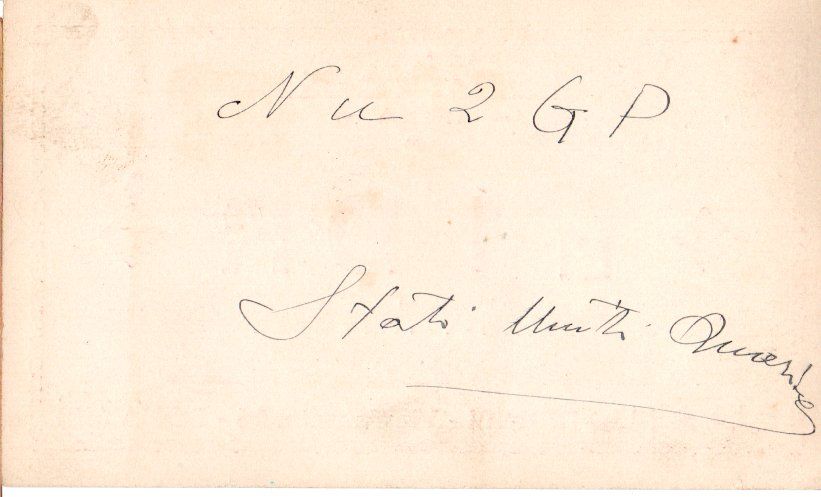
- Remarks: "I have heard you when you called me! Tnx OB! pse QSL!!!"; "pse QRK??????"; "QRA Giulio Dionisi – Via Taranto 26 – Roma (40)"; stamp "Radiofonia QSL Special Free Service"; back: "nu2GP, Stati Uniti d'America".
Key Specifications of 1DR
| Component | Description |
|---|---|
| Location | Via Taranto 26, Rome (1927–28); Via Machiavelli 48 (firm Scigliano e Dionisi, 1928) |
| Operator | Giulio Dionisi |
| Licence | Among the first nine Italian licences, September 1927; expiring 26 July 1928 |
| Power | 15 W input |
| Wavelengths | 41–43 m |
| Antenna | Zeppelin |
| Equipment | Hartley transmitter; modified Reinartz 0-V-1 receiver |
| Achievements | Heard in Australia (July 1927); telephony from December 1927; cross-mode phone/CW contact with av8AA (November 1928); points in the A.R.I. 1928 telephony contest |
Sources
- Il Radio Giornale, May, June, July, August, September (licence list), October (licence table and list of transmitters), November and December 1927; January, February, March, April, May, June, July–November (contest tables and entrants) and December 1928, p. 28; scans at introni.it.
- Radio Amateur Call Book, September 1928: 2GP, D. C. Sayer, Richmond Hill, N.Y.
- The card itself (front and back), K1FM collection.