Card images
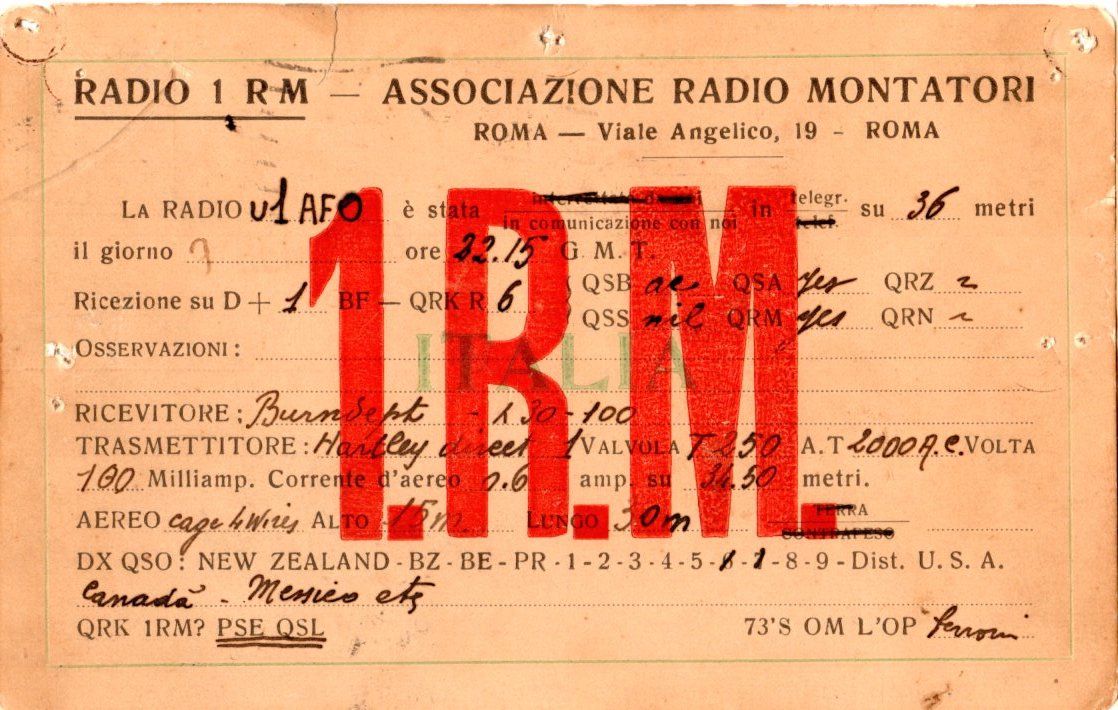
1RM
- Operator
- Associazione Radio Montatori
- QSO Time
- 22:15 GMT
- Mode
- CW
- Band
- 40m
1RM – Associazione Radio Montatori, Rome: The Club Station of the Army Radio Workshop
Introduction
"Radio 1RM – Associazione Radio Montatori – Roma – Viale Angelico 19": the sender of this card was not an individual but an association of radio fitters, and its address was a military one. Il Radio Giornale of May 1924 announced its foundation: "A Roma si è costituita, ad iniziativa di un gruppo di radiomontatori, l'Associazione Radio Montatori Officina Radio Genio. Scopo dell'Associazione: diffondere volgarizzare lo studio e le applicazioni pratiche della Radiotecnica e ciò per mezzo di lezioni, conferenze e costituendo una raccolta bibliografica e di materiali a disposizione dei soci. La Società nella sua sede al Viale Angelico N. 19…". Viale Angelico 19 was "l'Officina Radiotelegrafica ed Elettrotecnica del Genio militare di Roma" (September 1924), the Army Engineers' radio workshop, from which the association's station 1RM operated. Two other calls were later registered at the same address, 1OR (Officina Radio) and 1PM (Officina Radio Montatori).
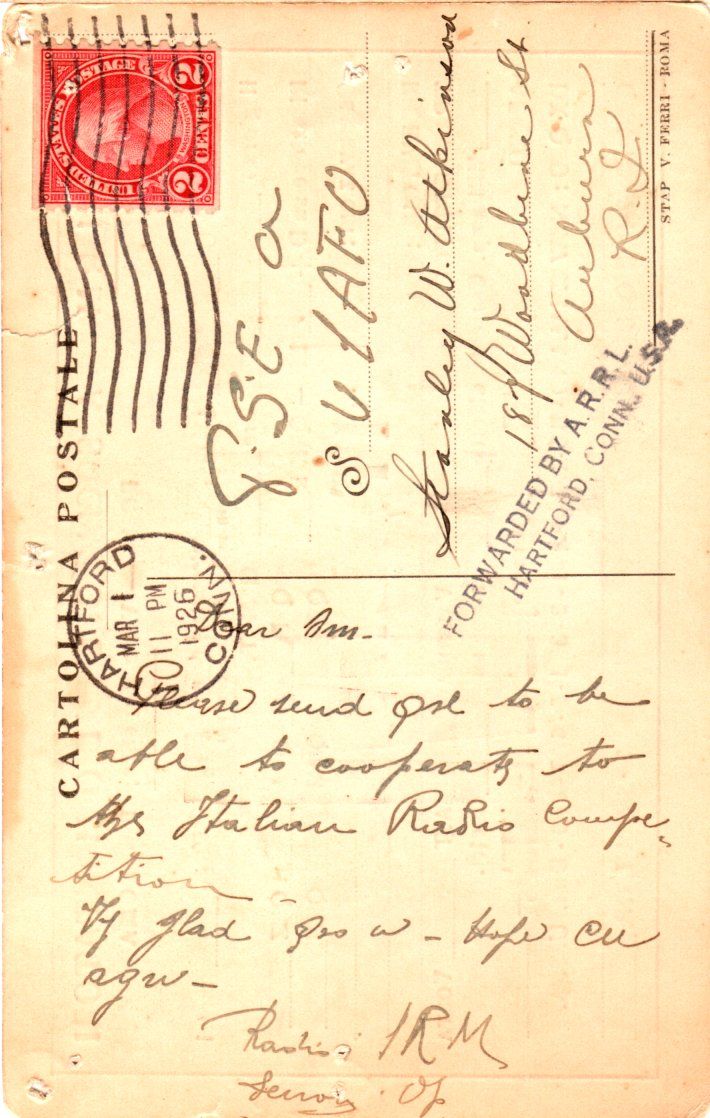
The card went to u1AFO, Stanley W. Atkinson of Woodbine Street, Auburn, Rhode Island, through the A.R.R.L. bureau (Hartford postmark 1 March 1926). No date is written, but the magazine's list of 1RM's contacts for January 1926 includes 1AFO; the note on the back, "Please send QSL to be able to cooperate to the Italian Radio Competition", refers to the R.C.N.I. contest then in progress.
Activity, 1925–1926
1RM entered the R.C.N.I. contest on 20 October 1925 and was heard in New Zealand two days later. Its monthly lists in Il Radio Giornale are among the longest of any Italian station: in November 1925, Porto Rico 4SA, New Zealand 2AC and twenty-one Americans; in December 1925, Bermuda (BER), Brazil (RGT), Canada 2BE, four New Zealanders and about thirty Americans, among them 3QT, which the Turin station 1NO would work two months later. The cumulative list printed in January 1926 ("Ricevitore 1+1BF, onda 30-45 metri") adds Argentina, Australia, Cuba, the Philippines, Indochina, Mexico and South Africa, and the magazine notes that the British amateur R. E. Williams had been received at 1RM "usando una potenza di soli 2,5 Watt".
The January 1926 list, which covers this card, reads: "Comunicazioni bilaterali eseguite nel mese di Gennaio: Brasile: 1AB. Messico: 1B. N. Zelanda: 1AQ, 2BX. Panama: 99X. Stati Uniti: 1AFO, 1AIR, 1ALL, 1ARE, 1BDX, 1BLB, 1BUO, 1CMF, 1CMX, 1CRE, 1GA, 1SZ, 2AHM, 2AWF, 2CJE, 2CPD, 2KG, 2UK, 3BHV, 3PY, 3WB, 5ATT, 8ADG, 8ALY, 8BWW, 8CES, 8CKM, 8NJ, 8XE. Totale: 34." A letter in the same issue, signed "p. l'Associazione Radio Amatori (1RM) Il Segretario: Guerzoni", claims a first: "Il giorno 5 Gennaio la stazione i1RM ha comunicato con il Messicano 1B; lo stesso Messicano asseriva essere questa la prima comunicazione avvenuta fra l'Italia e Messico. QRK di i1RM e 1B erano rispettivamente R7." It also answers a complaint: the French Journal des 8 had accused 1RM of jamming the DX band below 37.5 m, and the magazine had printed a "Monito a i1RM" in January; the secretary explains that the off-band transmissions were "causato da varii spostamenti subiti dalla nostra stazione per riparazioni ai locali". The complaints continued (in April 1926 f8JW and f3CA asked "i dilettanti di tutto il mondo di non rispondere più agli Italiani ed in particolare a 1RM").
February 1926 brought Canada 1DD and 1EI, Mexico 1AA, Porto Rico 4JE and twenty-six Americans. In the final classification of the 1925 contest (June 1926, pages 4–5) 1RM was fourth overall ("4° premio: grande medaglia di bronzo e valvola di trasmissione Philips all'Assoc. Radio Montatori"); four members appear in the group photograph of the prize-giving ("1, 2, 3, 6 Soci dell'Associazione Radiomontatori di Roma (1RM)") and three on the cover ("Soci della Associazione Radio Montatori (7, 8, 9)").
The summer of 1926 was the station's best season: in July, Australia (a2TM, 2YI, 7HL), Argentina, Mexico, six New Zealanders and the United States, with the note "La comunicazione con A 7HL (Tasmania) 19 luglio ore 5,30 G.M.T. Riteniamo essere la prima comunicazione fatta dall'Italia con il 7. Distretto degli Australiani"; in August, Australia, Brazil, New Zealand and "China: FC 8FLO" (Shanghai); in September, three Australians, Argentina, Brazil and five New Zealanders. Brunacci (1GW), five kilometres away, used 1RM as his test receiver, and the American 8JQ of Pittsburgh wrote that "Gli italiani che trasmettono su 36 metri fanno molto bene. 1GW, 1NO e 1RM si ricevono qui in buone serate anche alle ore 8 GMT". After 1926 the call appears only in foreign reception lists; it is absent from the October 1927 list of Italian transmitters, where the workshop's stations are 1OR and 1PM.
The card itself
- To: u1AFO, Stanley W. Atkinson, Woodbine Street, Auburn, R.I. (the card reads 184, the 1927–28 call books give 187). Telegraphy on 36 m at 22:15 GMT, received on detector + 1 BF, QRK R6, QSA yes, QRM yes.
- Receiver: Burndept, 30–100 m. Transmitter: Hartley direct, one T250 valve, 2,000 V AC, 100 mA, aerial current 0.6 A on 34.5 m.
- Aerial: cage, 4 wires, 15 m high, 30 m long.
- DX QSO: New Zealand, BZ, BE (Bermuda), PR, 1st–9th districts USA, Canada, Mexico etc.
- Signed "73's OM, l'op. Ferroni" (the name is not found in the magazine; the association's secretary in 1926 was Guerzoni). Back: "Dear OM, please send QSL to be able to cooperate to the Italian Radio Competition. Vy glad QSO u. Hope cu agn. Radio 1RM, Senior Op."; "Forwarded by A.R.R.L., Hartford, Conn."; printed by Stab. V. Ferri, Rome.
Key Specifications of 1RM
| Component | Description |
|---|---|
| Location | Viale Angelico 19, Rome (Officina Radiotelegrafica del Genio militare) |
| Operators | Members of the Associazione Radio Montatori (secretary Guerzoni, 1926; card signed "Ferroni") |
| Power | 2,000 V AC, 100 mA (card) |
| Wavelengths | 30–45 m (1925); 34.5–36 m (1926) |
| Antenna | 4-wire cage, 30 m long, 15 m high |
| Equipment | Hartley with one T250; Burndept receiver 30–100 m (card); 1 + 1 BF receiver (1925) |
| Achievements | Claimed first Italy–Mexico contact (5 Jan 1926) and first Italy–Tasmania contact (19 Jul 1926); Shanghai (Aug 1926); 4th in the R.C.N.I. 1925 contest with 34 bilaterals in January 1926 alone |
Sources
- Il Radio Giornale, May 1924 ("Dalle Società": foundation of the association) and September 1924, p. 22 (the Army radio workshop at Viale Angelico 19); November and December 1925; January 1926 (lists, "Monito a i1RM"), February 1926, pp. 14 and 17 (January contacts; Guerzoni's letter), March, May, June (pp. 4–5, 18), July, September, October and November 1926 (p. 8); scans at introni.it.
- Il Radio Giornale, October 1927 (list of Italian transmitters: 1OR and 1PM at Viale Angelico 19); 1927–28 reception lists; scans at introni.it.
- Amateur Radio Stations of the United States, June 1927 and June 1928; Radio Amateur Call Book, September 1928: 1AFO, Stanley W. Atkinson, 187 Woodbine St., Auburn, R.I.
- The card itself (front and back), K1FM collection.