Card images
1OP
- QSO Date
- 1928-12-25
- QSO Time
- 01:00-01:30 GMT
- Mode
- Phone
1OP – Florence: An Unlicensed Telephony Station at Christmas 1928
Introduction
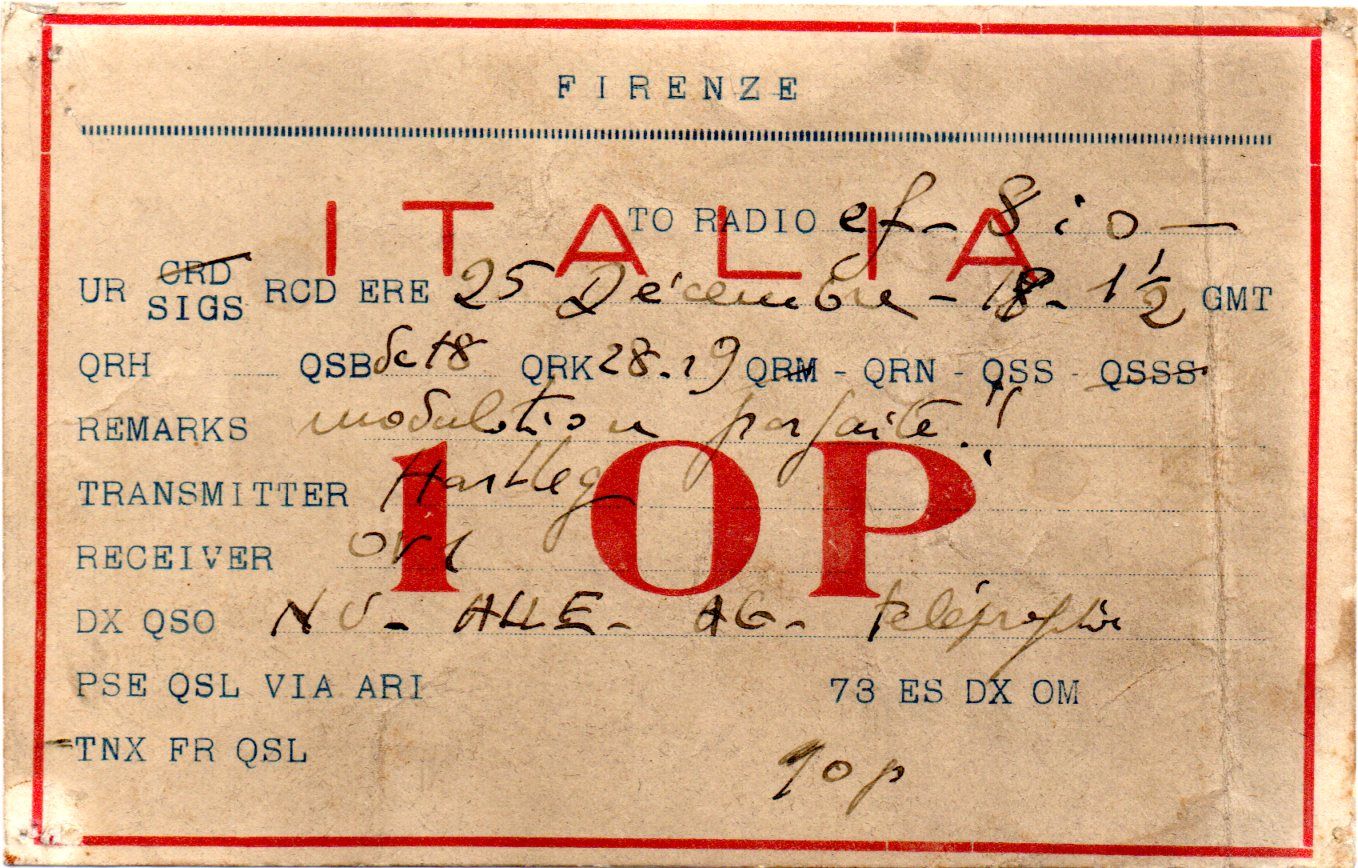
This is the most anonymous card in the collection and, for that reason, one of the most telling. It is printed simply "FIRENZE / ITALIA / 1OP", carries no operator's name or address, and is signed only "1OP". It reports, in French, that the signals of ef8IO were received in Florence on 25 December (1928) between 01:00 and 01:30 GMT at r8–r9 with "modulation parfaite!!", lists the station's own equipment (Hartley transmitter, 0-V-1 receiver) and its telephony DX ("NU - … - AG - téléphonie": the United States, and Algeria), and asks for a QSL "via ARI".
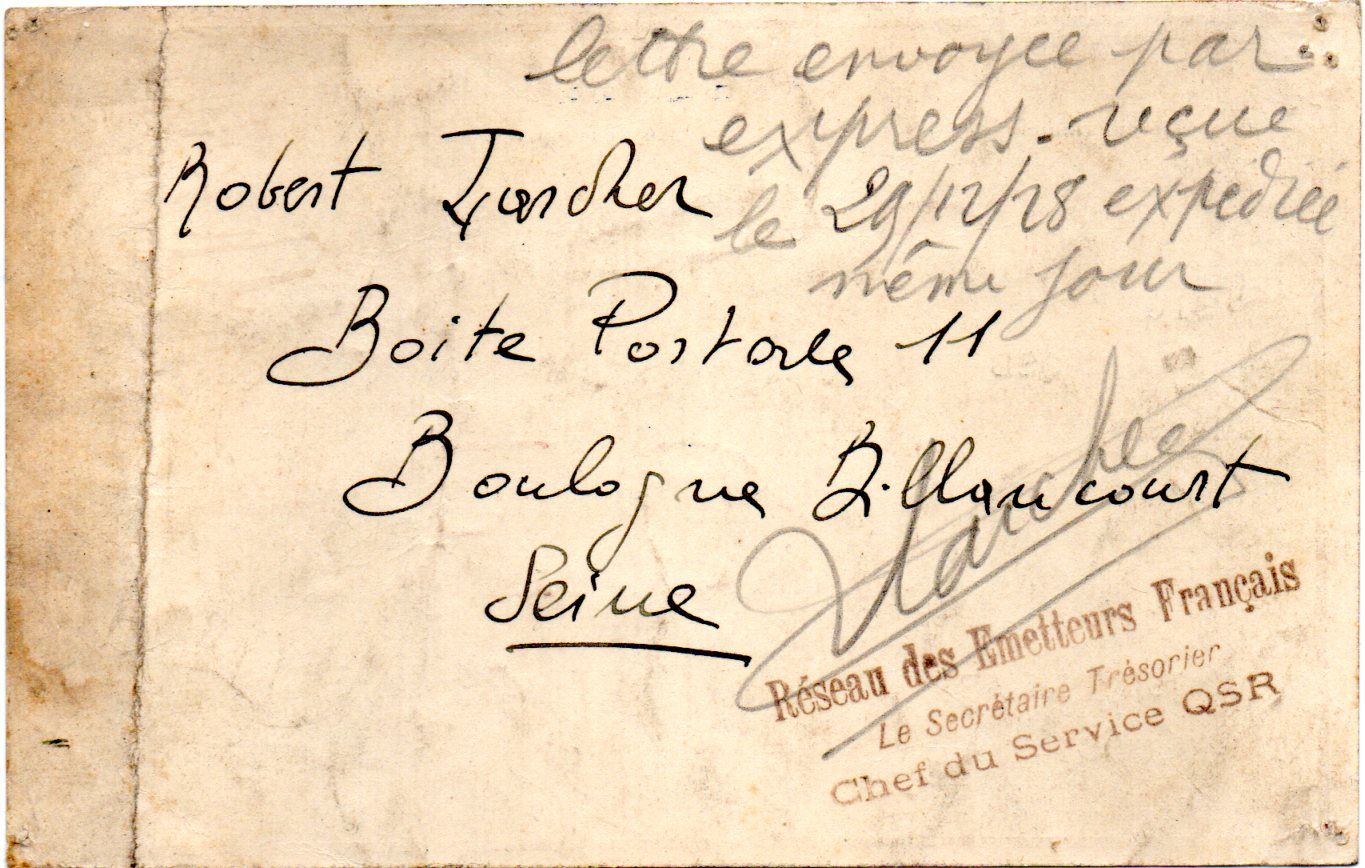
The back explains the route: the card was addressed to Robert Larcher, Boîte Postale 11, Boulogne-Billancourt, with the stamp "Réseau des Émetteurs Français – Le Secrétaire Trésorier – Chef du Service QSR", and a pencilled note "lettre envoyée par express, reçue le 29/12/28, expédiée même jour". Il Radio Giornale of May 1927 (page 30) had announced that "Il R.E.F. ha stabilita una sezione QSL e QRA sotto la direzione di Robert Larcher, 17 rue Fessart, Boulogne-Billancourt (Seine) al quale vanno indirizzate tutte le comunicazioni pei dilettanti francesi". The card therefore went to the French QSL bureau four days after the contact. The addressee station 8IO is listed in the September 1928 Radio Amateur Call Book as Roussel, 40 quai Fulchiron, Lyon.
Why the operator is unknown
The call 1OP does not appear anywhere in Il Radio Giornale between 1925 and December 1928: not in the monthly activity reports, not in the list of Italian transmitters of October 1927, not in the licence tables, not among the new calls the magazine announced through 1928. The Florentine stations of the period are 1AD (Fiorenzo Capecchi), 1CH (Elio Fagnoni, the A.R.I. delegate for Florence), 1CQ (Giovanni Caponi), 1DH (Vieri Guadagni), 1GE (Ezio Gervasoni) and 1RR (Giovanni Bargilli).
The silence is explained by the situation in Florence that year. In October 1928 the magazine reported: "L'attività radiotecnica dei trasmettitori della Sezione di Firenze è assolutamente nulla per le persecuzioni della polizia che ha operato anche un sequestro." Official transmitting licences had only begun to be issued in July 1927, and many Italian amateurs operated without one; a Florentine transmitting telephony to France at one in the morning on Christmas Day 1928, under a call that had never been published, had good reason to leave his name off the card. A post-war I1OP (Renzo Cappelli, later I5RNP) belonged to Livorno and is unrelated.
The card itself
- To: ef8IO (Roussel, Lyon, per the 1928 call book), "ur sigs rcd ere 25 Décembre 1h–1½ GMT"; QSB dc (DC supply), QRK r8–r9.
- Remarks: "modulation parfaite!!"
- Transmitter: Hartley. Receiver: 0-V-1.
- DX QSO: NU, AG and others, in telephony.
- "Pse QSL via ARI", "73 es DX OM", "Tnx fr QSL"; signed "1OP".
- Back: addressed to Robert Larcher, Boîte Postale 11, Boulogne-Billancourt (Seine), with the R.E.F. QSL-service stamp and the receipt note of 29 December 1928.
Key Specifications of 1OP
| Component | Description |
|---|---|
| Location | Florence |
| Operator | Unknown; the call was never published in Il Radio Giornale |
| Power | Not stated |
| Wavelengths | Not stated (the 1928 phone contacts of Italian stations were on 40–45 m) |
| Antenna | Not stated |
| Equipment | Hartley transmitter, DC supply; 0-V-1 receiver |
| Achievements | Telephony contacts with the United States and Algeria by December 1928 |
Sources
- Il Radio Giornale, May 1927, p. 30 (R.E.F. QSL section under Robert Larcher); October 1927 (list of Italian transmitters, Florence stations); October 1928 (note on the Florence section); scans at introni.it. The call 1OP was searched for in every issue from 1925 to December 1928 without result.
- Radio Amateur Call Book, September 1928, French section: 8IO, Roussel, Lyon.
- Federico Paoletti, Storia della radiodiffusione in Italia (federicopaoletti.it), entries for 1950 and December 1952 (post-war I1OP, Livorno).
- The card itself (front and back), K1FM collection.