Card images
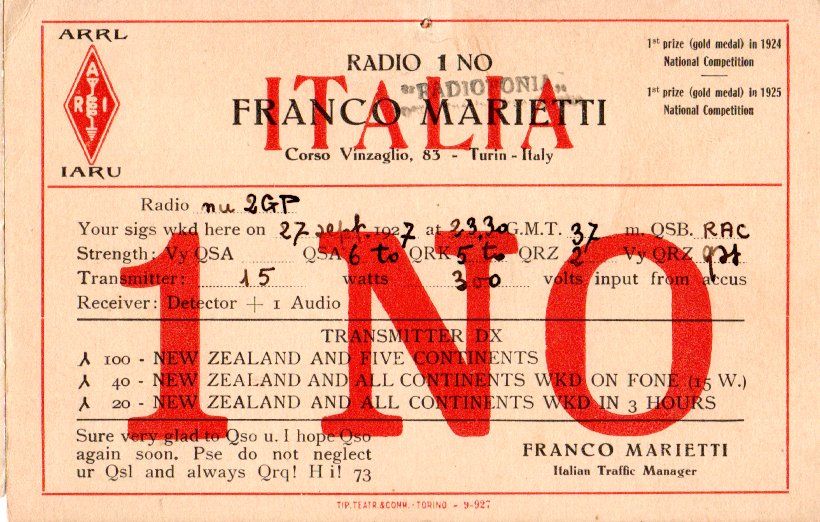
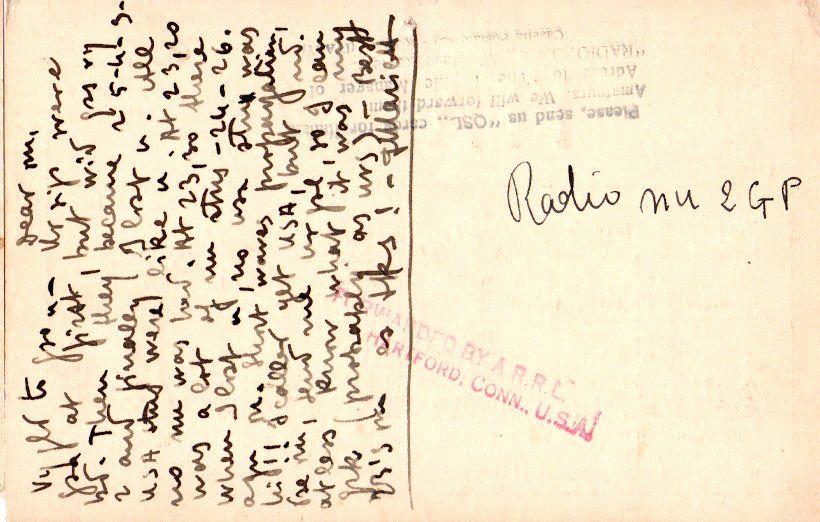
1NO
- Operator
- Franco Marietti
- QSO Date
- 1927-10-27
- QSO Time
- 23:30 GMT
- Mode
- Phone
- Band
- 40m
1NO – Ing. Franco Marietti, Turin: Fifteen Watts to New Zealand on Telephony
Introduction
By the autumn of 1927 Franco Marietti had become vice-president of the A.R.I., its "direttore di traffico" (the "Italian Traffic Manager" of the card), president of the new Turin section and, as this card proudly prints, "1st prize (gold medal) in 1924 National Competition – 1st prize (gold medal) in 1925 National Competition". His station had also changed character: where the 1926 card in this collection advertised 200 watts, this one declares "Transmitter: 15 watts, 300 volts input from accus", and its DX lines are about telephony: "λ100 – New Zealand and five continents; λ40 – New Zealand and all continents wkd on fone (15 W.); λ20 – New Zealand and all continents wkd in 3 hours". The card was printed in Turin in September 1927 ("Tip. Teatr. & Comm. Torino 9-927") and written for nu2GP, Donald C. Sayer of Richmond Hill, New York, after a contact on 27 October 1927 at 23:30 GMT on 37 metres.
The QRP telephony station of 1927
Il Radio Giornale of May 1927 describes the new approach in an editorial on thoriated-filament valves: "Con un triodo da 10 watt nella prima settimana di prove 1NO ha comunicato con circa 20 differenti stazioni oltre gli 8.000 chilometri; alla prima prova di portata in fonia: la Nuova Zelanda; alla prima prova sui 20 metri (19,50): cinque Continenti nello spazio di tre ore." The same issue gives his report: "Comunicazioni bilaterali eseguite dal 19 al 31 marzo (qrp, potenza da 5 a 15 watt)", with Argentina, Australia, Brazil, Costa Rica, the Philippines, India and Mexico, and "Riassunto delle prove in fonia iniziate il 18 marzo", in which oz1FQ in New Zealand reports "La vostra fonia buona … Ho udito i vostri 'Allo New Zealand'"; "Potenza 5 a 15 watt con 100 a 300 volt di tensione anodica (batteria per ricezione OHM), Antenna spaziale Lévy. Modulazione diretta sull'oscillatrice." Marietti's contest report of May–June 1928 confirms the figures on the card: the transmitter was fed by "300 volt di accumulatori per ricezione Ohm", with "corrente di placca … 50 milliampere e quindi la potenza alimentazione di 15 watt", and "in telefonia abbiamo realizzato fino dai primissimi giorni delle nostre prove la prima comunicazione in fonia tra l'Italia e la Nuova Zelanda … il nostro corrispondente era in grado di ripetere in grafia quanto dicevamo in fonia". An OHM battery advertisement run in the magazine through 1927 makes the same claim: "Franco Marietti 1NO (Torino) vincitore del concorso di ricezione 1924 (ADRI) e del Campionato Italiano 1925 (Radiogiornale) trasmettendo con 3 batterie per ricezione OHM comunica in telefonia con gli Antipodi." The 1924 gold medal of the card was thus for the A.D.R.I. reception contest, the 1925 one for the R.C.N.I. transmitting championship.
In May 1927 1NO also became a broadcaster: "Quasi tutta l'attività di 1NO si è svolta su quest'onda [300 m] trasmettendo seralmente concerti con la partecipazione di artisti del Teatro Regio … circa 400 lettere entusiastiche da tutto il Piemonte" (June 1927), announcing itself "Pronto, pronto. Qui stazione radiosperimentale della Sezione di Torino dell'Associazione Radiotecnica Italiana". On 21 June 1927 the Turin section elected him president ("su 31 votanti 29 schede portano il nome di Franco Marietti") and declared his station its official one. In August 1927 he ran a radio link from the university students' camp at Passo Sella to Turin, where the correspondent was 1UU, Agostino Criscuoli (see I1UU-1927-01), and he closed the first A.R.I. congress at Como in September.
The months around this card were his best DX season on low power. The November 1927 issue reports "i1NO mese di settembre - Grafia: 8 distretti; mese di ottobre: Grafia 9 distretti; Fonia con Europa e Australia", and January 1928 summarises: "Prima comunicazione Europa - Camerun (bilaterale con fqPM). Il 12 novembre … contemporanea con ne8RG a Terranova e xep1MA a Shangai … Il 27 novembre bilaterale con oa7CH (Tasmania) … Il 25 dicembre bilaterale con oz1AN … Comunicazioni in fonia con l'India, il Marocco, la Nuova Zelanda, l'Australia, la Siria". In the Saturday A.R.I. phone net "tutti su 40-45 metri fuorché 1NO su 33 metri".
In June 1928 the A.R.I. published the final classification of its 1927 contest: "L'ing. Franco Marietti risulta quindi vincitore del concorso ARI 1927 e riceve la medaglia d'oro diploma e titolo di campione italiano per il 1927", ahead of 1MA, 1CR and 1UU. He opened the second A.R.I. congress in Turin in October 1928 and from 1928 formed, with Gnesutta and Montù, the three-man presidency committee of the association.
The card itself
- To: nu2GP (D. C. Sayer, Richmond Hill, N.Y.). "Your sigs wkd here on 27 Oct 1927 at 23.30 GMT, 37 m, QSB RAC; QSA 6 to 5 to 2, vy QRZ".
- Transmitter: 15 watts, 300 volts input from accumulators. Receiver: detector + 1 audio.
- Transmitter DX: λ100 New Zealand and five continents; λ40 New Zealand and all continents wkd on fone (15 W); λ20 New Zealand and all continents wkd in 3 hours.
- Printed "Radio 1NO – Franco Marietti – Corso Vinzaglio 83 – Turin"; "Italian Traffic Manager"; ARRL / IARU; A.R.I. diamond; Radiofonia stamp; "Sure very glad to QSO u. I hope QSO again soon. Pse do not neglect ur QSL and always QRQ! Hi! 73".
- Back: a long note: "…when I lost u, no USA stn was agn in. Short waves propagation hi!! I called yet USA, but nd. So pse OM, send me ur QSL, so I can at least know what it was my QRK (probably as urs). Best 73's OM es tks! – Marietti"; "Forwarded by A.R.R.L., Hartford".
Key Specifications of 1NO (1927)
| Component | Description |
|---|---|
| Location | Corso Vinzaglio 83, Turin |
| Operator | Ing. Franco Marietti; A.R.I. vice-president (1927), traffic director (May 1927), president of the Turin section (June 1927), Italian champion 1925 and 1927 |
| Power | 5–15 W from 300 V of receiving accumulators (1927); 10 W on 300 m broadcasting |
| Wavelengths | 32–37 m (CW and phone); 19.5 m; 300–360 m (broadcast tests, May–July 1927) |
| Antenna | Lévy ("antenna spaziale Lévy") |
| Equipment | 10-watt thoriated triode, direct modulation of the oscillator; detector + 1 audio receiver |
| Achievements | First Italy–New Zealand telephony contact (March 1927); five continents in three hours on 19.5 m; first Europe–Cameroon contact (1927); Newfoundland and Shanghai simultaneously (12 Nov 1927); Tasmania and New Zealand (Nov–Dec 1927); winner of the A.R.I. 1927 contest |
Sources
- Il Radio Giornale, January, March, April (OHM advertisement), May (pp. 28–29, 36), June, July, August, September, October and November 1927; January, February, May and June 1928 (contest report pp. 8–10 and classification p. 29), July, October and December 1928; scans at introni.it.
- Radio Amateur Call Book, September 1928: 2GP, D. C. Sayer, Richmond Hill, N.Y.
- Federico Paoletti, Storia della radiodiffusione in Italia (federicopaoletti.it), entries for March 1927 and 7 May 1927.
- The card itself (front and back), K1FM collection.