Card images
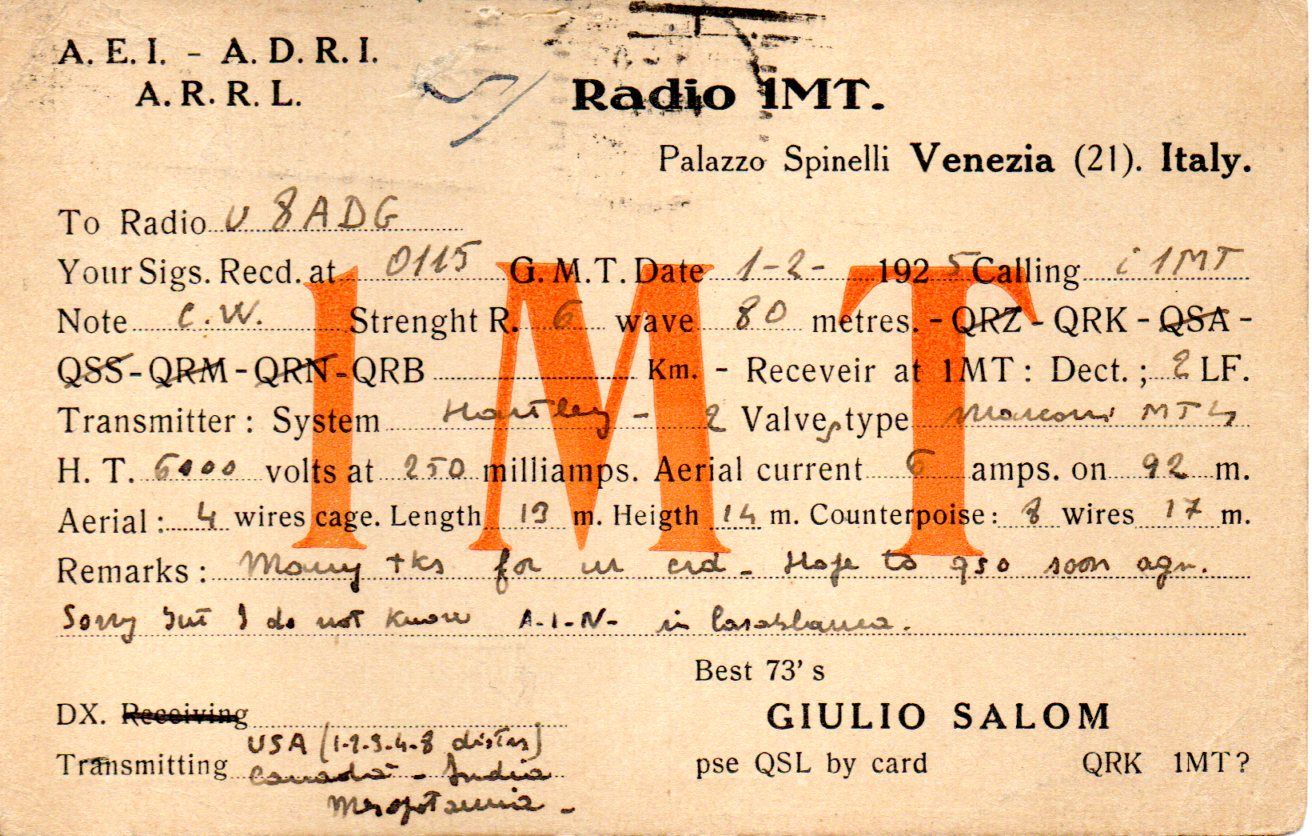
1MT
- Operator
- Giulio Salom
- QSO Date
- 1925-02-01
- QSO Time
- 01:15 GMT
- Mode
- CW
- Band
- 80m
1MT – Giulio Salom, Venice: The First Italian Short-Wave Station

Il Radio Giornale of January 1924 announces that Giulio Salom of Venice, "per specialissima concessione del Ministero Poste e Telegrafi", has been transmitting on valves and 200 metres since 1 December 1923 under the call 1MT.

The station 1MT in Palazzo Spinelli, from Salom's own article "La Stazione 1MT (Giulio Salom) – Venezia", Il Radio Giornale, April 1924, pages 17–18.
Introduction
Giulio Salom's station in Palazzo Spinelli, on the Grand Canal at Sant'Angelo, was the first Italian amateur station on short waves and, by the magazine's own account, the first to establish regular two-way contacts between Italy and the rest of Europe. The first notice reads: "Il sig. Giulio Salom di Venezia ci comunica che dal 1° Dicembre 1923, per specialissima concessione del Ministero Poste e Telegrafi, sta eseguendo esperienze di trasmissione a valvola su onde corte (200 m.). Egli è già riuscito a comunicare bilateralmente con Inghilterra, Francia, Olanda e Danimarca con soli 100 watt d'energia oscillante … Il nominativo della stazione è 1MT" (January 1924). The station list of February 1924 contains only three Italian calls: 1MT, 1GNS (Gnesutta) and 1RCL (Radio Club Lombardo). Whether this was formally the first licence issued by the Italian state is asserted by secondary sources (Paoletti) rather than by the magazine, which records that Adriano Ducati (ACD) was also active in January 1924.
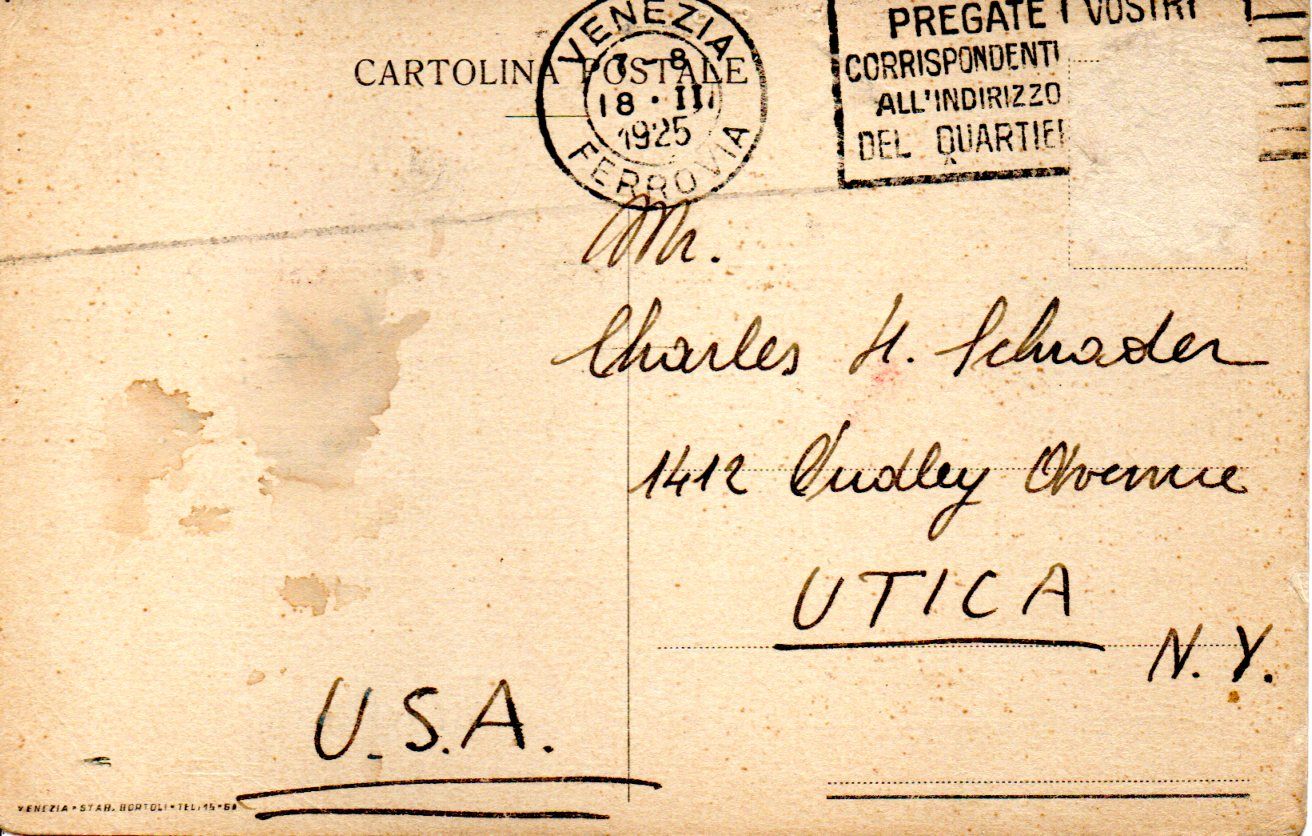
The card in the collection was written for u8ADG, Charles H. Schrader of 1412 Dudley Avenue, Utica, New York, after Schrader's signals were received at 01:15 GMT on 1 February 1925 calling i1MT, and posted in Venice on 18 March 1925. 8ADG is one of the thirty-one American stations the magazine credits 1MT with working in five nights of February 1925.
The station in 1923–1924
Salom's April 1924 article describes the beginnings: "Nello scorso mese di dicembre in seguito a speciale concessione avuta dal Ministero delle Poste e dei Telegrafi abbiamo potuto eseguire … esperienze di trasmissione radiotelegrafica a valvola su onde di 200 metri", managing "a comunicare con stazioni situate a più di 1500 Km. da Venezia con un'energia oscillante di soli 125 watt, ed a stabilire per la prima volta delle regolari comunicazioni senza fili bilaterali su onde corte tra l'Italia e le altre Nazioni Europee". Of the circuits tried, "Colpitt, Hartley ed il Reversed feedback … ci siamo particolarmente serviti di quest'ultimo", with "una valvola S.I.F. da 250 watt … placca alimentata a corrente alternata 2000 volts, 42 periodi" and up to 3 A in the aerial. On the night of 8 December 1923 he worked 8BM (Lille), 8BF (Orléans) and 0AR (Amsterdam) on 198 m, and the next night, for more than two hours, 2HF near Birmingham, "1500 Km".
The aerial was "tubolare ad L … lunghezza di 14 metri, con discesa … di 16 metri" on the roof of "nostro Palazzo posto sul Canal Grande", with "contrappeso di 9 fili di una ventina di metri, disposti a ventaglio". "Il 1° Gennaio 1924 la valvola S.I.F. da 250 watt fu sostituita con una Marconi tipo MT4 … 6000 volts … dai 4 ai 5 ampères sull'aereo"; the longest distance was "Edimburgo nella Scozia a 2000 Km … forza 9" (5DN at Sheffield also heard him "colla cuffia sul tavolo"). In May 1924 the magazine reported "1MT udito in America": the 198 m signals had been received "con molta intensità dalla Stazione americana 2CTJ situata a Schenectady", and the A.R.R.L. said other American stations had heard him too. Through 1924 1MT was logged at Norwich, Felixstowe, Worksop, Manchester, The Hague and in the United States.
1925: America, India, Mesopotamia and the antipodes
"1MT (Salom, Venezia) ha comunicato nei due sensi il 22 gennaio alle ore 23 su 95 m. con M1 (Mosul, Mesopotamia). La stazione 1MT ha circa 6 àmperes nell'aereo su 95 m." (February 1925, page 20; the item breaks off in the magazine). In March 1925 (page 16): "1MT (Giulio Salom, Venezia) ci comunica che le stazioni americane colle quali ha comunicato bilateralmente in 5 notti del mese di febbraio sono in numero di 31 e precisamente: 1AR 1MY 1PL 1BSD 1ARY 1SF … 2BRC 2CEE … 3CHG 3BTA … 4FZ 4SA 8ADG. Inoltre gli è giunta comunicazione ufficiale che i suoi segnali sono stati uditi in India con buona intensità e precisamente a Cachar (350 Km. N.E. di Calcutta)". The card's "DX transmitting: USA (1-2-3-4-8 districts), Canada, India, Mesopotamia" is this record in short, and the 6 amperes on 92 m and the two Marconi MT4 valves at 6,000 volts are the station of the Mosul contact.
In March 1925 1MT and 1NO were the first Italian signals heard in New Zealand, on 90 m (Salom's letter, October 1925), and "nella seconda decade di luglio" 1MT worked the New Zealanders 2AA, 2AE and 2AC and the Australian 4AR on 40 m with "400 watt antenna" (August 1925). In October 1925 he published radiograms received from the Nizhny Novgorod radio laboratory and from New Zealand, made "su onda 32 metri, potenza 250 watt a 500 periodi" and "su onda di 41 metri, potenza 600 watt a 42 periodi". R. W. Mintrom of Christchurch logged 1MT twenty times up to 8 January 1926, more than any other Italian. In April 1926 the magazine lists a second call at the same address, "1NA – Giulio Salom – Palazzo Spinelli – Venezia".
The organiser
Salom was offered the presidency of the Radio Club Veneto when it was formed in April 1924, sat on the A.D.R.I. council as president of the Venice section (December 1924), and was Italy's delegate, with Marietti, at the founding congress of the I.A.R.U. in Paris in April 1925 ("Parlano in seguito Marcuse 2NM … Salom i1MT per l'Italia"). In October 1925 he and Marietti were appointed to the ministerial commission on the regulation of broadcasting, as members of the U.R.S.I. From 1927 he was an A.R.I. councillor and delegate for the province of Venice; he received one of the first nine official licences in September 1927 ("1MT Salom Giulio – Venezia", expiring 31 December 1927) and transmitted telephony on Saturdays on 41 m. The magazine styles him "Dott." and in August 1927 lists his book Le radiocomunicazioni nel diritto internazionale (CEDAM, Padua).
His best-known later work was the "Ondina" field transmitter with which Giuseppe Biagi called for help from the "Red Tent" after the crash of the airship Italia in May 1928. Salom wrote to the magazine on 25 July 1928, signing as "Consulente Tecnico della R. Marina": "la stazione trasmettente campale usata dai naufraghi dell'«Italia» … tale apparecchio è stato progettato da me e costruito e collaudato sotto la mia personale direzione presso l'Officina r.t. del R. Arsenale M.M. della Spezia." The October 1928 issue shows transmitter no. 001 of the series ("Biagi's was no. 003"), "costruiti … su esclusivo progetto del dott. Giulio Salom, socio e consigliere della A.R.I.": 55 x 22 x 25 cm, 12 kg, a Philips TB 04-10, 30–55 m. His dates of birth and death were not found.
The card itself
- To: u8ADG, Charles H. Schrader, 1412 Dudley Avenue, Utica, N.Y. "Your sigs recd at 0115 GMT, date 1-2-1925, calling i1MT. Note CW, strength R6, wave 80 metres."
- Receiver at 1MT: detector + 2 LF. Transmitter: Hartley, 2 Marconi MT4 valves, H.T. 6,000 volts at 250 mA, aerial current 6 A on 92 m.
- Aerial: 4-wire cage, 19 m long, 14 m high; counterpoise 8 wires, 17 m.
- Remarks: "Many tks for ur crd. Hope to QSO soon agn. Sorry but I do not know A-1-N in Casablanca."
- DX transmitting: USA (1-2-3-4-8 districts), Canada, India, Mesopotamia.
- Printed A.E.I. – A.D.R.I. – A.R.R.L., "Radio 1MT, Palazzo Spinelli, Venezia (21)"; "pse QSL by card, QRK 1MT?"; back postmarked Venezia Ferrovia 18-III-1925.
Key Specifications of 1MT
| Component | Description |
|---|---|
| Location | Palazzo Spinelli, Sant'Angelo, Venice, on the Grand Canal |
| Operator | Dott. Giulio Salom; A.D.R.I. Venice section president (1924), I.A.R.U. Paris delegate (1925), A.R.I. councillor and delegate for Venice (1927–28), technical consultant of the Royal Navy (1928) |
| Power | 100–125 W oscillating (1923–24); 250 W at 500 cycles on 32 m and 600 W at 42 cycles on 41 m (1925); 6,000 V x 250 mA (card) |
| Wavelengths | 198–200 m (1923–24); 95 m (Jan 1925); 80–92 m (card); 40 m (July 1925); 32 m (1925); 41 m telephony (1927–28) |
| Antenna | Tubular L, 14 m + 16 m, 9-wire fan counterpoise (1924); 4-wire cage 19 x 14 m, 8-wire counterpoise (1925) |
| Equipment | Reversed feed-back with S.I.F. 250 W, then Marconi MT4 (1924); Hartley with two MT4 (1925); det + 2 LF receiver |
| Achievements | First Italian short-wave station (1 Dec 1923) and first regular Italy–Europe two-way contacts; heard at Schenectady (1924); Mosul (22 Jan 1925); 31 American stations in five nights (Feb 1925); heard in India; first Italian heard in New Zealand (Mar 1925, with 1NO); New Zealand and Australia worked (Jul 1925); designer of the Italia expedition's "Ondina" transmitter (1928) |
Sources
- Il Radio Giornale, January 1924 (first notice), February 1924 (station list, first contacts), April 1924, pp. 17–18 ("La Stazione 1MT (Giulio Salom) – Venezia") and "Dalle Società" (Radio Club Veneto), May 1924 ("1MT udito in America"), October–December 1924; February 1925, p. 20, March 1925, p. 16, April, June, August, October (pp. 18–20), November and December 1925; March, April and May 1926; scans at introni.it.
- Il Radio Giornale, January 1927 (A.R.I. council), May 1927 (photograph on the Perla), August 1927 ("Libri ricevuti"), September–November 1927 (licences, list of transmitters, letter of 1 November 1927), December 1927 and January 1928 (telephony schedule), August 1928 (letter of 25 July 1928) and October 1928 (transmitter no. 001); scans at introni.it.
- Radio Amateur Call Book, September 1928, and US Department of Commerce list, June 1926: 8ADG, Charles H. Schrader, 1412 Dudley Ave., Utica, N.Y.
- Federico Paoletti, Storia della radiodiffusione in Italia (federicopaoletti.it), entries for 1923–24 and 25 May 1928; radiomarconi1895.altervista.org, "Ondina 33" (designed under Dott. Giulio Salom, Arsenale of La Spezia).
- The card itself (front and back), K1FM collection.