Card images
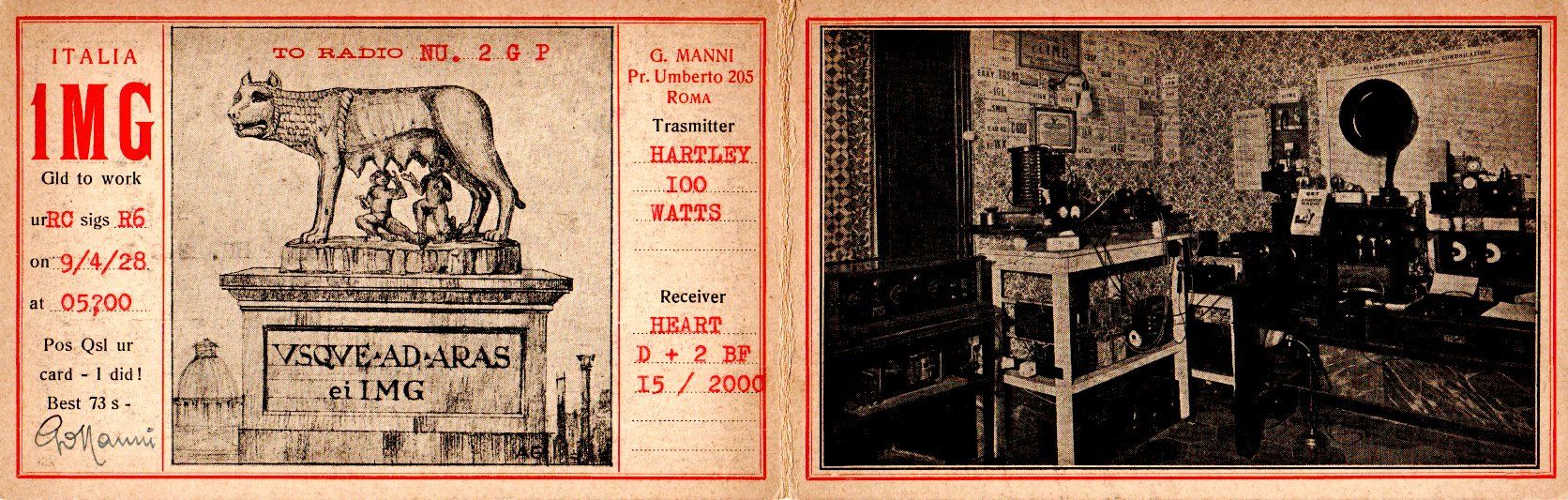
1MG
- Operator
- G. Manni
- QSO Date
- 1928-04-09
- QSO Time
- 05:00
- Mode
- CW
- Band
- 40m
ei1MG – G. Manni, Rome: "Usque ad aras", with a Photograph of the Station
Introduction
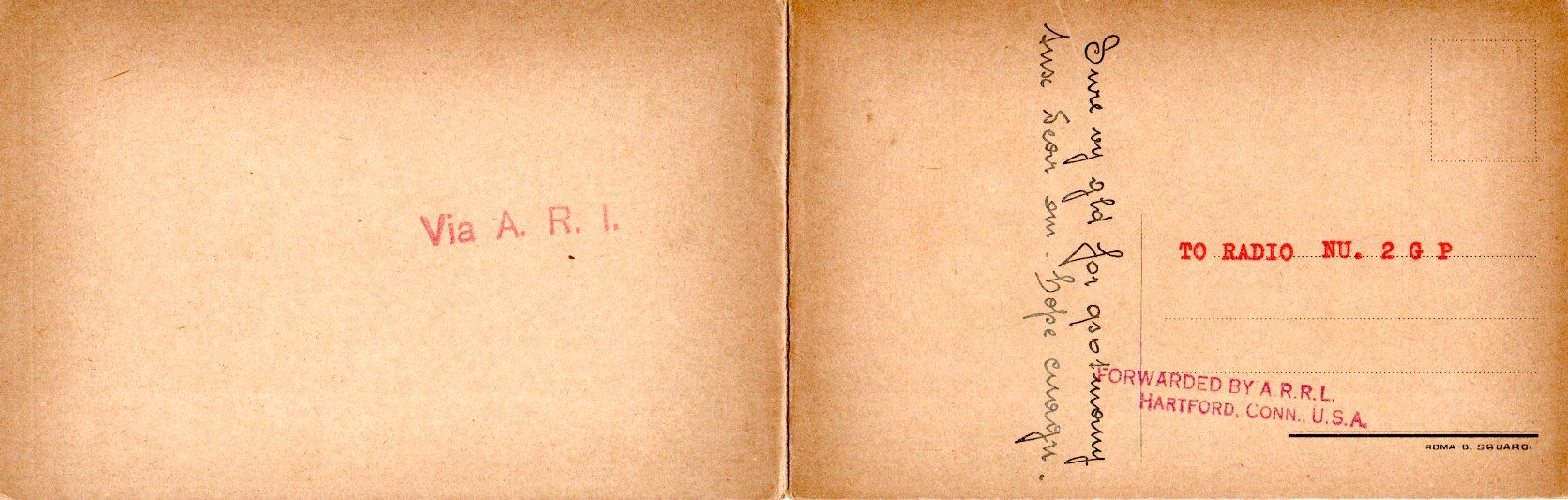
The second card from G. Manni's station in Via Principe Umberto 205, Rome (see also EI1MG-1927-01), is a folding card of unusual design: on the left a drawing of the Capitoline wolf on a pedestal inscribed "VSQVE AD ARAS – ei1MG", on the right a photograph of the station room with its wall of QSL cards and a horn loudspeaker. Il Radio Giornale printed the same photograph in November 1928 (page 34), captioned "ei 1MG", in its survey of Italian amateur activity. The card confirms a contact with nu2GP, Donald C. Sayer of Richmond Hill, New York, on 9 April 1928 at 05:00, with "RC sigs R6" (rectified AC note), and adds "Pos QSL ur card – I did!"; the back carries "Via A.R.I.", "Sure vy gld for QSO, hope cuagn" and the Hartford forwarding stamp.
The station in 1928
The magazine's monthly lists show ei1MG heard across Europe and beyond in the first half of 1928: in Spain in February (in telephony, with poor modulation), at Reims, in Syria, in Egypt, in Barcelona, Uppsala, Berlin, Barmen and Königsberg between January and March, in Estonia and in Sweden in May and June, and in Madrid and Barcelona in August. Manni published no activity reports of his own and did not enter the A.R.I. contests; his first name and profession are not recorded.
Between the two cards the transmitter grew from 75 to 100 watts, still a Hartley, while the receiver remained the "Heart" with detector and two audio stages covering 15–2,000 m. Of the two Rome QSL services of the period, this card went through the A.R.I. bureau rather than that of the magazine Radiofonia used for the 1927 card.
The card itself
- To: nu2GP; "Gld to work ur RC sigs R6 on 9/4/28 at 0500".
- Transmitter: Hartley, 100 watts. Receiver: Heart, D + 2 BF, 15–2,000 m.
- Printed "G. Manni, Pr. Umberto 205, Roma", "Italia 1MG", drawing of the Capitoline wolf, photograph of the station; "Best 73s"; back: "Via A.R.I.", "To Radio nu2GP", "Forwarded by A.R.R.L., Hartford, Conn.", printed Roma – G. Sguarci.
Key Specifications of 1MG
| Component | Description |
|---|---|
| Location | Via Principe Umberto 205, Rome |
| Operator | G. Manni |
| Power | 100 W (1928); 75 W, 1,800 V DC (1927) |
| Wavelengths | 43 m (1927 card) |
| Antenna | Single wire 25 m long, 40 m high (1927 card) |
| Equipment | Hartley transmitter; Heart receiver D + 2 BF |
| Achievements | Station photograph published in Il Radio Giornale, November 1928; heard throughout Europe, in Egypt and Syria, 1928 |
Sources
- Il Radio Giornale, February, March, April, May, June and August 1928 (reception lists); November 1928, p. 34 (photograph "ei 1MG"); scans at introni.it.
- Radio Amateur Call Book, September 1928: 2GP, D. C. Sayer, Richmond Hill, N.Y.
- The card itself (front and back), K1FM collection.