Card images
1GW
- Operator
- Bruno Brunacci
- QSO Date
- 1926-01-01
- QSO Time
- 03:50 GMT
- Mode
- CW
- Band
- 40m
1GW – Bruno Brunacci, Rome: "La stazione tiberina" and the First Italy–Ecuador Contact
Introduction
Bruno Brunacci's 1GW, in Via Evangelista Torricelli 1, close to the Tiber in Rome, was one of the most productive Italian DX stations of 1925–1926. Il Radio Giornale printed his monthly lists of two-way contacts, his long contest report "La stazione tiberina" (November 1926) and, in December 1926, his account of the first short-wave contact between Italy and Ecuador, which produced a telegram to Mussolini. Brunacci was a founding councillor of the A.R.I. in January 1927 and was re-elected to its council for 1929–30.
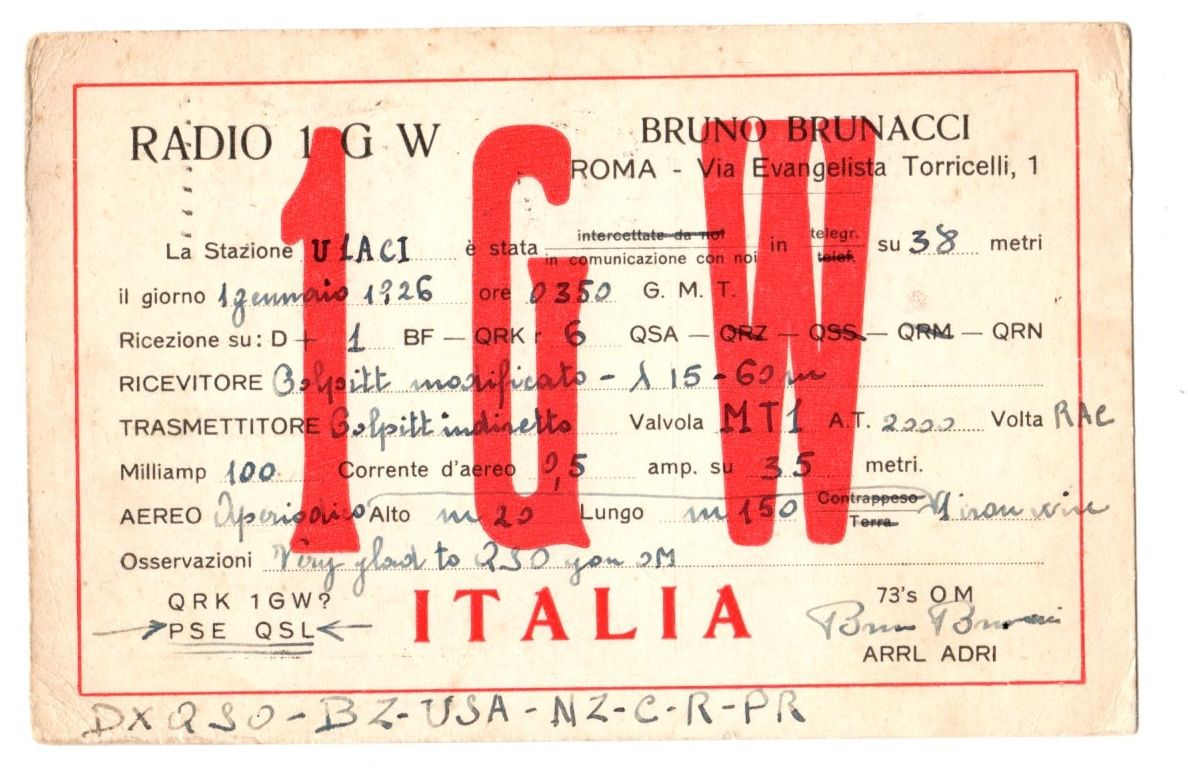
The card in the collection confirms a contact on 38 metres with u1ACI, Allan W. Gordon of 29 Dexter Street, Attleboro, Massachusetts, on 1 January 1926 at 03:50 GMT, received r6 on a detector and one audio stage. The magazine's list of 1GW's January 1926 contacts (February 1926, page 14) includes 1ACI among seventeen American stations.
Six months of DX (autumn 1925 – spring 1926)
1GW enters the "Le vie dello spazio" column in October 1925 with a report for September listing stations heard and worked in Australia, Brazil, Canada, Cuba, Mexico, New Zealand, the polar ships WAP and WNP and about 150 Americans. On 1 November 1925 at 05:40 GMT he worked the Argentine rAA8 (G. Fontana, Buenos Aires) on about 35 m; in October he had made bilaterals beyond 10,000 km with bz2IAC, bz1AF, z2AE and z2AC, and the contest table credits him with z2AE on 15 October 1925. The monthly lists then run: November (Argentina AA8, Brazil, Canada 2FO, Porto Rico 4SA, fourteen Americans); December (Argentina, Brazil 1AB 1AC 1AN 1BD, Canada 2BE 3KP, New Zealand 2XA 4AC, twenty-five Americans); January 1926, the month of this card:
"Comunicazioni bilaterali eseguite durante il mese di gennaio: Argentina: AA8. Brasile: 1AB, 1AC, 1AI, 1AX. Canadà: 1AR, 2BE. Messico: 1AA. Nuova Zelanda: 2XA, 3AF. Panama: 99X. Porto Rico: 4JE. Stati Uniti: 1ACI, 1BGQ, 1CAK, 1RD, 1SZ, 2AHM, 2BIR, 2CVJ, 2KX, 3CHG, 3HG, 4RR, 4RZ, 4WE, 8ES, 8ZAE, 9AOT. Con rAA8 in comunicazione il 6 ed il 26 gennaio, AA8 ha eseguito alcune prove di telefonia … Onda portante QRK r6, modulazione r3 parole indistinguibili a causa QRN. Con bz1AC si sono avute durante i mesi di dicembre e gennaio 16 comunicazioni, alcune delle quali durate circa due ore."
In February he added Chile (ch2LD), and in April 1926 the magazine summarised his "records" of the winter: "Prima comunicazione Italia-Panama con 99X (11 gennaio). Prima comunicazione Italia-Cile con 2LD (6 e 14 febbraio); Prima comunicazione Italia-Uruguai con 2AI (4 marzo)", plus receptions in Cape Town, Johannesburg, Valparaíso and Santiago. In May 1926 he reported contacts with the Philippines (piCD8, 23 April) and with TUK at Tomsk in central Siberia (20 April), "le prime eseguite dall'Italia"; in August 1926 the first Italy–Shanghai contact (fc8FLO, 15 August).
In the R.C.N.I. "Concorso di radioemissione 1925" (June 1926, pages 4–5) 1GW was third overall, behind Marietti (1NO) and Pozzi (1AS), with "3° premio: grande medaglia di bronzo e altoparlante Safar"; the table credits him with 31 bilateral points and second place for the written report. He appears as number 2 in the cover photograph of the competitors and number 7 in the prize-giving group of 17 May 1926.
"La stazione tiberina" (November 1926)
Brunacci's contest report, printed in November 1926 (pages 4–8) as "La stazione i1GW. La stazione tiberina", describes exactly the station on this card. The aerial was "un vecchio filo telefonico di ferro zincato del diametro di 2 mm … una campata lunga circa 200 metri … traversava diagonalmente il fiume Tevere … alta dal letto del fiume 25 m. e da terra 12 m." (iron wire until December 1925, phosphor-bronze from January 1926), and "non è stato usato nè terra nè contrappeso". The transmitter was "il Colpitt leggermente modificato" with a Marconi MT1 ("Filamento: 9 volta 5 ampere. Placca: 8000 volta"), fed in October and November 1925 with raw 45-cycle AC at 3,000 V and 60 mA, and from December 1925 "la corrente alternata è stata raddrizzata per mezzo di 2 diodi Marconi MR1 … Con un consumo di 200 watt (2000 Volta 100 mA)". The receiver was a Colpitts-derived autodyne with one audio stage covering 12–60 m. He worked "dalle 400 alle 500 GMT nei giorni feriali e dalle 400 alle 700 GMT nei giorni festivi", on 35.5 m and then 34 m, and lists the countries of the six months: "Brasile; Stati Uniti (1,2,3,4,5,8,9); Nuova Zelanda; Canadà (1,2,3); Argentina; Porto Rico; Panama; Messico; Cile; Uruguai", the same list the card abbreviates as "DX QSO – BZ – USA – NZ – C – R – PR".
A March 1927 article on transmitting valves recalls "il procedimento escogitato da uno dei migliori dilettanti italiani, 1GW, per fare funzionare il proprio MT1": a heavy grid voltage that brought the grid to white heat and perforated it, after which "i risultati ottenuti in seguito da 1GW sono ben conosciuti". A classified advertisement of November 1926 ("1GW vende trasmettitore ricevitore completi … Scrivere via Torricelli, 1 Roma") confirms the address printed on the card; by September 1927 he had moved to Via Oslavia 37.
Italy–Ecuador, December 1926
The Italian Military Mission in Quito had already heard 1GW on 22 March 1926. His letter printed in December 1926 (page 22) reads: "Le faccio noto che la mattina del 7 corrente ho comunicato per la prima volta con la Missione Militare Italiana a Quito Equatore. Le comunicazioni sono seguitate nei giorni successivi con scambio di messaggi fra i quali ne ho ricevuto uno per S. E. Mussolini." He then quotes the Interior Ministry press office of 12 December: "Ieri mattina alle ore 5 è stata effettuata per la prima volta una comunicazione radiotelegrafica fra l'Italia e l'Equatore per mezzo di stazioni ad onde corte dei dilettanti maggiore Fava di Quito e Brunacci di Roma. La comunicazione è avvenuta su onde di m. 36 e 32 rispettivamente e con potenze di circa 200 watt. I segnali sono stati ricevuti con tanta intensità che la Missione Militare Italiana a Quito ha potuto giovarsene per inviare all'On. Mussolini il seguente telegramma: «S. E. Mussolini - Roma Dilettanti radiotelegrafia maggiore Fava in Quito e Brunacci in Roma riusciti comunicare. Italiani Equatore sentono alleviata nostalgia Patria esultano poter inviare per tramite trasmissione italiana loro devozione. - Ministro d'Italia: Filetti»." The first contact was therefore on 7 December 1926, with about 200 watts on 32 m. The same letter thanks the editor for a Japanese QSL "dove sento con piacere che la mia stazione è la prima italiana e la seconda europea ricevuta colà. QRK r6-7." (Major Fava may be the "maggiore Giovanni Fava" of Alessandria, 1AC, in the 1925 licence list quoted by Paoletti, but this is not confirmed.)
Later years
In January 1927 Brunacci was among the first councillors of the new A.R.I. ("Consiglieri: Bruno Brunacci, Giuseppe Fontana, Dr. Silvio Pozzi, Giovanni Colonnetti, Giulio Salom, Francesco P. Pagliari"). In 1927 he was heard throughout Europe, in Canada and Uruguay, and transmitted "tutte le sere alle 23 GMT su 44 m." From the autumn of 1928 1GW was a telephony station ("ei-1GW - r5-6 mod. prof. nota leggermente nasale 100%"; "28-X ore 16,45: 1GW, r7, ottima, fonia 100%"), received the A.R.I. "Stazione distinta" diploma in November 1928 and headed the list of councillors elected for 1929–30.
The card itself
- To: u1ACI, Allan W. Gordon, 29 Dexter Street, Attleboro, Mass. (the June 1927 and 1928 US lists; the handwritten "Gordon Dexter" is the name and street). Telegraphy on 38 m, 1 January 1926, 03:50 GMT, received on detector + 1 BF, QRK r6.
- Receiver: Colpitts modified, 15–60 m. Transmitter: Colpitts indirect, MT1 valve, 2,000 V rectified AC, 100 mA, aerial current 0.5 A on 35 m.
- Aerial: aperiodic, 20 m high, 150 m long; counterpoise: iron wire (the river-spanning wire of the November 1926 article).
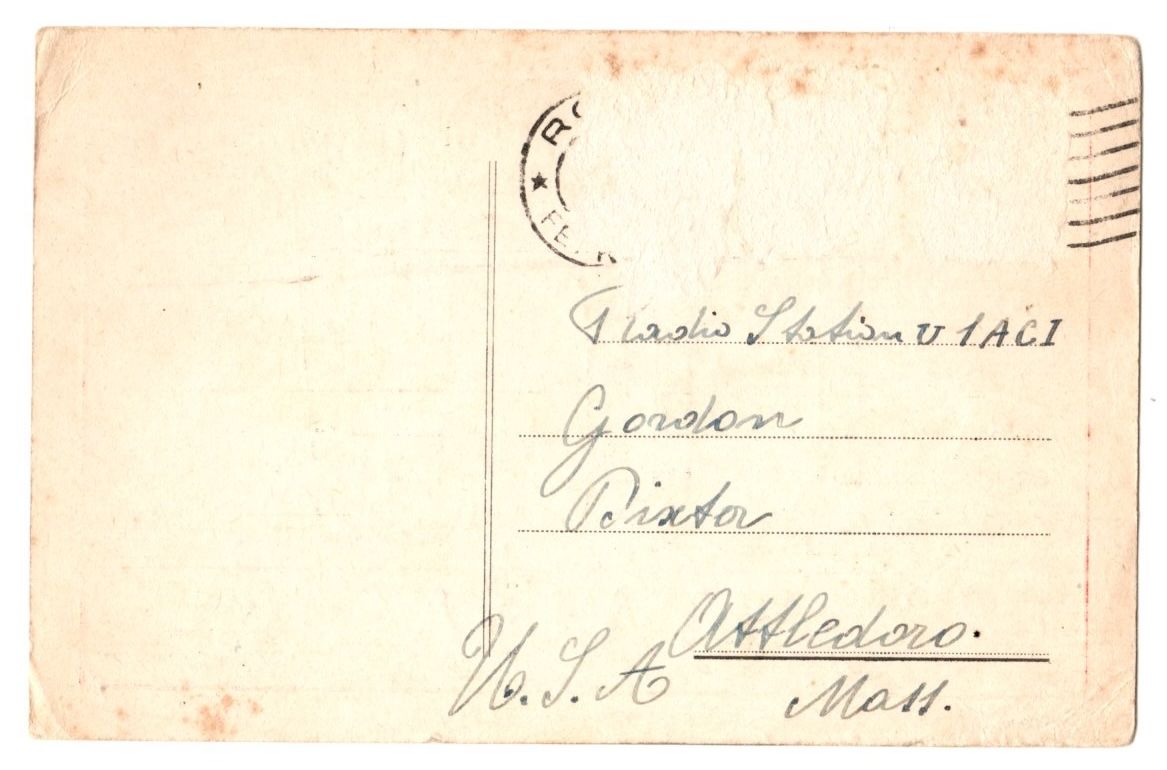
- Remarks: "Very glad to QSO you OM"; "DX QSO – BZ – USA – NZ – C – R – PR"; printed ARRL – ADRI; back addressed "Radio Station u1ACI, Gordon, Dexter, Attleboro, Mass., U.S.A." with a Rome postmark.
Key Specifications of 1GW
| Component | Description |
|---|---|
| Location | Via Evangelista Torricelli 1, Rome (1925–26); Via Oslavia 37 from 1927 |
| Operator | Bruno Brunacci; A.R.I. councillor 1927 and 1929–30 |
| Power | 3,000 V x 60 mA raw AC (Oct–Nov 1925); 200 W, 2,000 V rectified, 100 mA (from Dec 1925); about 200–250 W (1926) |
| Wavelengths | 35.5 then 34 m (1925–26); 30–33 m (1926); 32 m (Ecuador, Dec 1926); 44 m (1927) |
| Antenna | Single 200 m iron (later bronze) wire across the Tiber, 12–25 m high, no earth or counterpoise |
| Equipment | Modified Colpitts with Marconi MT1 (8,000 V rating), two MR1 rectifiers; Colpitts autodyne receiver + 1 LF, 12–60 m |
| Achievements | First Italian contacts with Panama (11 Jan 1926), Chile (Feb 1926), Uruguay (4 Mar 1926), the Philippines and Siberia (Apr 1926), Shanghai (15 Aug 1926) and Ecuador (7 Dec 1926); 3rd in the 1925 national contest; telegram to Mussolini from Quito |
Sources
- Il Radio Giornale, October, November and December 1925; January, February (p. 14), March, April, May, June (pp. 4–5 and 18), July, September, October and November 1926 (pp. 4–8, "La stazione i1GW. La stazione tiberina"; classified ad p. 22); December 1926, p. 22 (Ecuador letter); scans at introni.it.
- Il Radio Giornale, January, February, March (p. 8), May, September and October 1927 (A.R.I. council, valve article, schedule, new QRA); October, November and December 1928 (telephony reports, "Stazione distinta", council election); scans at introni.it.
- Amateur Radio Stations of the United States, June 1926, June 1927 and June 1928; Radio Amateur Call Book, September 1928: 1ACI, Allan W. Gordon, Attleboro, Mass.
- Federico Paoletti, Storia della radiodiffusione in Italia (federicopaoletti.it), entry for 15 January 1925 ("1GW Bruno Brunacci - Roma"; "1AC maggiore Giovanni Fava - Alessandria").
- The card itself (front and back), K1FM collection.