Card images
1CY
- Operator
- Francesco Saverio Salimei
- QSO Date
- 1927-08-10
i1CY – Francesco Saverio Salimei, Rome: A Reminder Sent to France through the "Radiofonia" QSL Service
Introduction
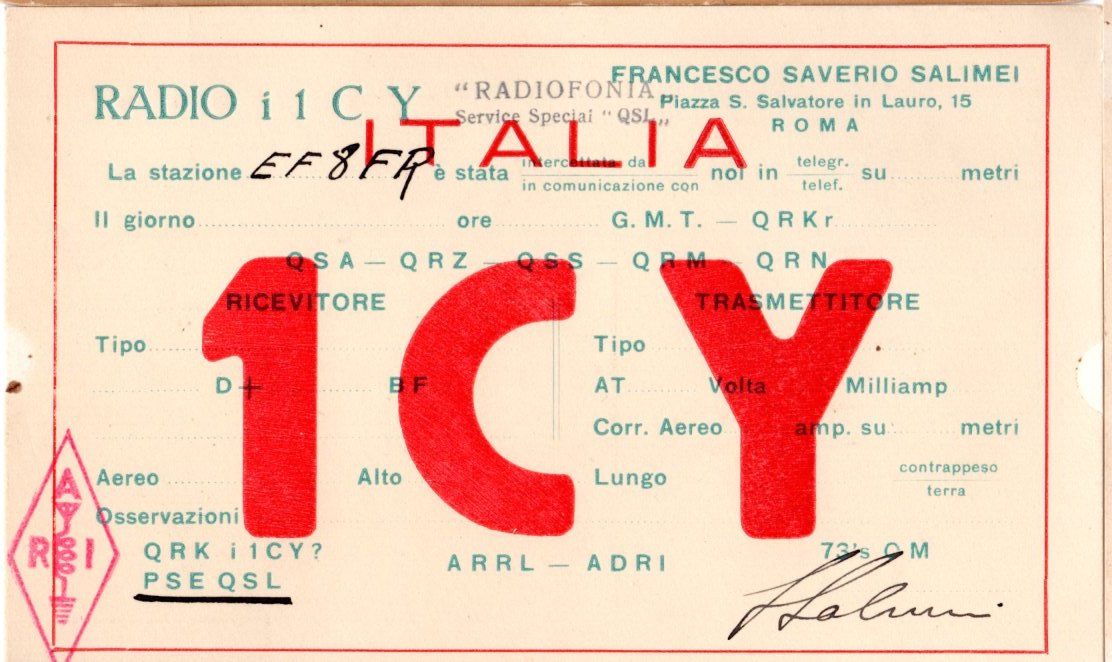
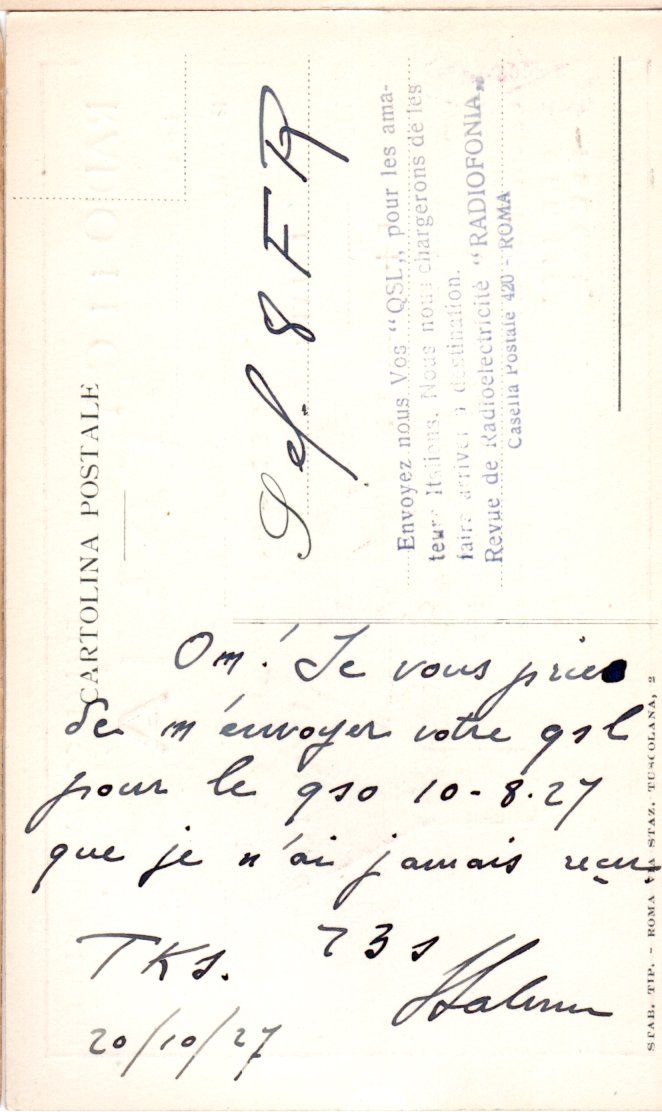
This card was not written to confirm a contact but to chase one. On 20 October 1927 Francesco Saverio Salimei, of Piazza S. Salvatore in Lauro 15 in Rome, used his printed i1CY card to write in French to ef8FR: "OM! Je vous prie de m'envoyer votre QSL pour le QSO 10-8-27 que je n'ai jamais reçu. Tks. 73s." The card itself is of a type printed for the QSL service of the Rome magazine Radiofonia ("Radiofonia – Service Speciali QSL" on the front; on the back, in French, "Envoyez nous vos QSL pour les amateurs italiens. Nous nous chargerons de les faire arriver à destination. Revue de Radioélectricité Radiofonia, Casella Postale 420 – Roma"), and it also carries the initials of the A.R.R.L. and of the A.D.R.I., the Milan association that merged into the A.R.I. on 1 January 1927. Radiofonia was a fortnightly founded in Rome in April 1924 by Augusto and Raoul Ranieri, sons of the founder of the Araldo Telefonico; three cards in this collection (1CY, 1DR, 1MG) passed through its QSL service.
1CY in Il Radio Giornale
The magazine names Salimei once, in the list of Italian transmitters of October 1927: "1CY - Francesco Saverio Salimei, Piazza S. Salvatore in Lauro, 15, Roma (11)". He held no A.R.I. office (the Rome delegate was Umberto Martini), published no reports and entered no contests, but his signals were widely heard in 1927. In May 1927 the magazine relayed a complaint: "All'Estero si lamenta un qrm da parte di dilettanti italiani che trasmettono su onde vietate agli Europei: 1CY, 1PN, 1MA e in particolare 1PL (Journal des 8) … Il Journal des 8 contiene nel suo numero del 23 aprile u.s. una vibrata protesta contro i dilettanti italiani 1PN (36 m.), 1CY (36 m.) e 1PL (36 m.)." The same issue notes that 1CY had been called by the Uruguayan su1CX. Between July and November 1927 the call appears in the reception lists of listeners in Spain (e008, e037, Sanlúcar), Germany (Murnau, Leipzig, Berlin, Wittenberg), and above all France (R268 in Paris, Laval, Toulouse, Gagny in August, Reims, Aumale, Pau, Bourges, Brittany), which fits a contact with ef8FR on 10 August 1927. In December 1927 1CY is still in the lists, and in April 1928 a listener logged "ei1CY: buona: r3" in telephony.
The addressee ef8FR was an active French station from at least 1926, when the Tripoli station i1TA worked it seven times; the September 1928 call book lists 8FR as Robert Dubs of Mulhouse. The Vicenza card EI1FO-1927-01 in this collection is also addressed to ef8FR.
The card itself
- Printed: "Radio i1CY – 'Radiofonia' Service Speciali QSL – Francesco Saverio Salimei – Piazza S. Salvatore in Lauro, 15 – Roma"; "QRK i1CY? PSE QSL"; "ARRL – ADRI"; A.R.I. diamond stamp; "73's OM", signed Salimei. The station fields are blank; "La stazione EF8FR … ITALIA".
- Back (French): "OM! Je vous prie de m'envoyer votre QSL pour le QSO 10-8-27 que je n'ai jamais reçu. Tks. 73s", dated 20/10/27, signed Salimei; printed Radiofonia notice; printed Stab. Tip. Roma, via Staz. Tuscolana 2.
Key Specifications of 1CY
| Component | Description |
|---|---|
| Location | Piazza S. Salvatore in Lauro 15, Rome |
| Operator | Francesco Saverio Salimei |
| Power | Not stated |
| Wavelengths | 36 m (spring 1927, per Journal des 8) |
| Antenna | Not stated |
| Equipment | Not stated |
| Achievements | Widely heard in France, Spain and Germany in 1927; telephony by 1928; called by Uruguay (1927) |
Sources
- Il Radio Giornale, May 1927 (QRM complaint from the Journal des 8; su1CX), June–December 1927 (reception lists), October 1927 (list of Italian transmitters), May 1928 (telephony report); June 1926 (i1TA's contacts with 8FR); scans at introni.it.
- Federico Paoletti, Storia della radiodiffusione in Italia (federicopaoletti.it), entry for 20 April 1924 (Radiofonia, Rome, Augusto and Raoul Ranieri).
- Radio Amateur Call Book, September 1928, French section: 8FR, Robert Dubs, Mulhouse.
- The card itself (front and back), K1FM collection.