Card images
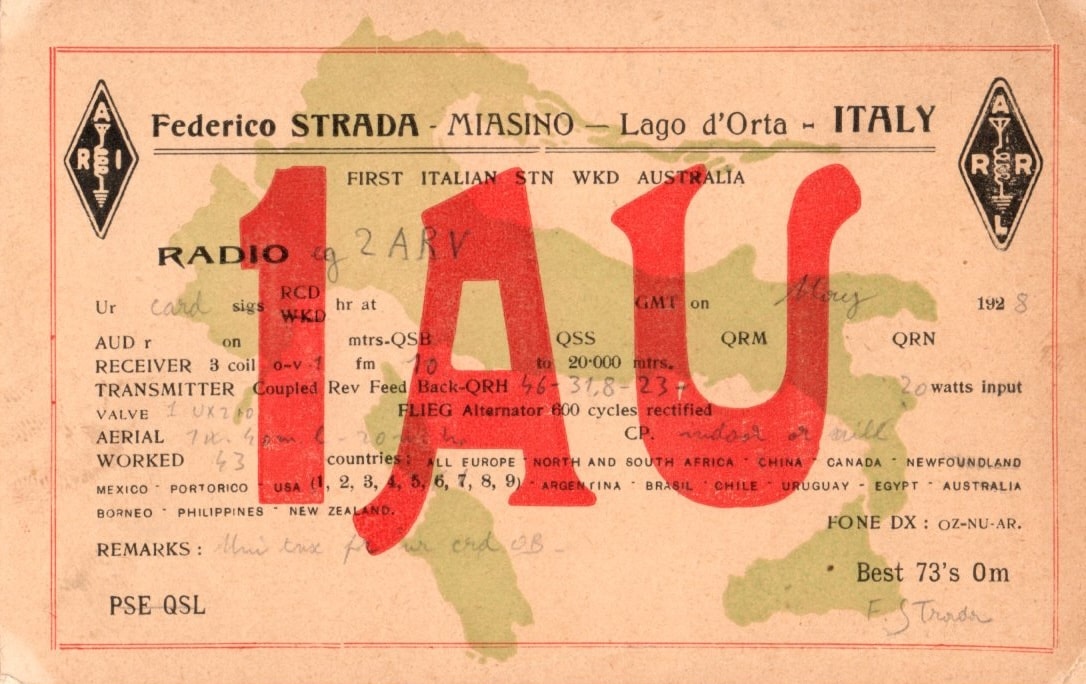
1AU
- Operator
- Federico Strada
- QSO Time
- GMT
1AU – Federico Strada, Miasino: The First Italian Station to Work Australia

Il Radio Giornale (December 1925, page 3, "Note di redazione") announces "a new and brilliant Italian result": on 9 October i1AU established the first two-way Italy–Australia contact, working a2YH.
Introduction
The claim printed across the top of this card, FIRST ITALIAN STN WKD AUSTRALIA, is one of the few boasts on a 1920s QSL that can be checked line by line against the contemporary press. Federico Strada's station 1AU was reported month after month in the "Le vie dello spazio" column of Il Radio Giornale, the organ of the Radio Club Nazionale Italiano (R.C.N.I.) and, from 1927, of the Associazione Radiotecnica Italiana (A.R.I.). Those reports confirm the Australian "first" of October 1925, document a long run of low-power DX from the shore of Lago d'Orta in 1926, and describe the telephony work of 1927 that the card itself summarises as "Fone DX: OZ-NU-AR".
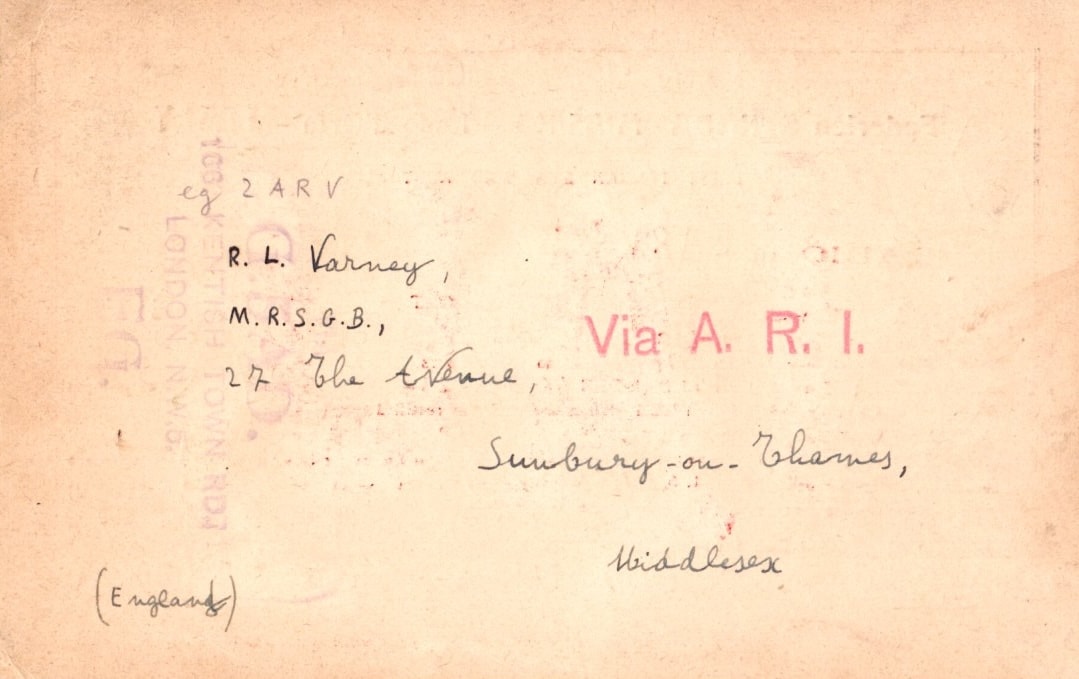
The card in the collection was filled in in May 1928 for eg2ARV, R. L. Varney, M.R.S.G.B., of 27 The Avenue, Sunbury-on-Thames, and sent through the A.R.I. QSL bureau ("Via A.R.I." stamp on the back). It carries both the A.R.I. and the A.R.R.L. diamonds and lists 43 countries worked.
Who was Federico Strada
The station first appears under Turin. Federico Paoletti's chronology of Italian radio, quoting the list of the first licensed Italian amateurs published in January 1925, gives "1AU Federico Strada – Torino" and adds that he later became director of FIVRE, the Italian valve manufacturer established in Pavia in 1932 (this later career rests on that single secondary source). Il Radio Giornale of November 1925 still lists him as "1AU – Federico Strada – Radio-Torino", and in December 1925 the station takes part, together with 1CO, in the Morse "corso di lettura al suono" broadcast for Radio-Torino on 96 metres every Saturday and Tuesday at 23:30, with a "600-cycle a.c. note". That 600-cycle note is the same Flieg alternator supply still printed on the 1928 card.
From the summer of 1926 the activity reports are headed "i1AU Miasino – Lago d'Orta" or simply "1AU (Lago d'Orta)", which is the QTH printed on this card. Miasino sits on the eastern shore of the lake, a few kilometres from Gozzano, home of the better-known Silvio Pozzi, i1AS (see the card I1AS-1926-01 in this collection); the two stations appear side by side in the New Zealand and Australian logs of the period.
The Italy–Australia first (October 1925)
The sequence is documented in three consecutive issues of Il Radio Giornale:
- November 1925, page 13. "i1AU communicated on 9 October at 08:00 with the Australian a2YH." The same column reports two-way contacts with the New Zealander z2AE on 5 October (06:45, reported r6-7) and 10 October (r5-6), with 80 watts input, and lists for October the bilaterals with New Zealand 2AE, Australia 2YH and the USA (1BES). The list of calls heard by 1AU that month includes ten Australians (2YH, 2TM, 2TO, 2YI, 3BD, 3AK, 3XO, 3EF, 5BG, 5KN).
- December 1925, page 3. The editorial reproduced above: "i1AU established on 9 October the first two-way Italy–Australia communication, working a2YH."
- December 1925, page 14. "i1AU has been received at Mombasa (South Africa) and, according to information received, turns out to be the first Italian station that communicated bilaterally with Australia (9 October 1925 with a2YH)." The same issue, in the standings of the Radiogiornale DX contest, credits i1AU with contacts over 10,000 km with the New Zealanders z2XA and z2AC on 26 September 1925.
The other side of the contact, a2YH, was the Sydney station of Walter Henry Hannam, wireless operator of Mawson's Australasian Antarctic Expedition of 1911–14 and a founding member of the Wireless Institute of Australia.

In May 1926 the magazine summarised the pioneering contacts in a "Table of the principal DX in amateur radio communications". The last row credits i1AU (Strada) with the "prima bilaterale telegrafica Italia-Australia" with a2YH. Note that the table gives the date as "9 Settem. 1925", whereas the two reports printed at the time of the event, quoted above, say 9 October; the September date is in all likelihood a misprint. The same table shows what came before: Ernesto Montù's i1RG had been heard in Australia on 14 June 1925, but no Italian had completed a two-way contact.
Low-power DX from Lago d'Orta (1926)
Strada's reports of 1926 read like a deliberate low-power programme, always noting an input "below 95 watts" with E4M valves:
- 15–30 August 1926 (September issue): two-way with the Philippines (pi1AU), Chile (ch2AH), Mexico (M1N), Uruguay (y1CD), Australia (a2IJ), seven New Zealand stations, five Brazilians and twelve Americans. A set of graded tests with the US station NOWC gave r8 at 90 W, r9 at 65 W, r6-7 at 11 W, r7-4 (with fading) at 6 W, r6 at 3 W, r5 at 1.5 W and still r4 at 0.14 W (56 volts at 2.5 mA). F8MN in Paris reported r9 with 11 W and "always r9" with 1.5 W.
- September 1926 (October issue): Australia a2SH, Borneo, eleven New Zealanders, Brazil, Mexico, eighteen US contacts and Canada c9CD, plus reception reports from Australian listeners (A3ES, A3LS, A3WM) and a QSL from a broadcast listener in Sydney.
- 1–10 October and 6–9 November 1926 (December issue), under 90 W: Australia 2RG and 4RB, South Africa oA4V, New Zealand z1AO, 2BD, 2GC and 2XA, Brazil bz1AL, Canada c2BF (r9). 1AU was also heard in California (u6ZAT, u6BXO), in Indochina (fi8QQ, Saigon) and by several Australians.
Reception lists throughout 1926 place 1AU among the Italian signals heard in New Zealand (R. W. Mintrom of Christchurch logged him five times up to 8 January 1926), Great Britain, Spain, Austria and the Philippines.
Telephony in 1927: "Fone DX: OZ-NU-AR"

By the autumn of 1927 Strada had turned to radiotelephony. Il Radio Giornale of December 1927 (page 21) reports that "in one week of work between October and November 1AU worked in telephony about fifty stations on five continents". European contacts were made on 44 metres with 20 watts on 42-cycle raw AC; DX contacts on 31.8 metres with 60 watts on 600-cycle AC. The New Zealander oz2BR, "enthusiastic about 1AU's telephony both for quality and strength", copied voice and music perfectly at R4-5, and more than sixty reception reports arrived for that single week, British, Scottish, Belgian, French, Spanish and Italian listeners giving R8–R9. The same issue lists ei1AU among the Italian phone stations heard in Lithuania, Spain, France and Germany between September and November 1927.
These figures match the card exactly: the printed wavelengths 46 / 31.8 / 23 metres, the 20 watts input to a single UX210, and the "Fone DX: OZ-NU-AR" line, i.e. telephony contacts with New Zealand, the United States and Argentina under the 1927 intermediate prefixes.
The station described by its owner (May 1928)

The operating room at Miasino, with the wall of QSL cards, as photographed for Il Radio Giornale of May 1928 (page 10).
In the same month in which this card was written, Il Radio Giornale published a four-page article signed "Federico Strada – Radio 1AU" (May 1928, pages 10–13), the most complete description of the station. It opens with a wry account of the licence: "after nine long months of anxious waiting, the long-awaited transmitting licence finally arrived", an authorisation that allowed transmissions only from 12:00 to 13:00 and from 23:00 to 24:00, exclusively on 43 metres, with every modification to be submitted to the Ministry of Communications for approval. Strada then describes the site: Miasino, about 300 metres above the level of Lago d'Orta, halfway up the mountainside and surrounded by tall conifers, so that the aerial, a 40-metre copper wire running north–south at an angle of about 18°, had to be strung between the top of a cedar of Lebanon and a 17-metre pole on the roof of the station.
The power supply is the heart of the article. After months of running filament and plate on raw 42-cycle mains, and then rectifying the 42 cycles with two E4M triodes used as diodes (which at 80–90 watts could not give a pure note without enormous filter capacitors), Strada installed a Telefunken "Flieg" aircraft alternator: a single aluminium frame carrying the exciter dynamo and two alternators on one shaft, 600 cycles at 4,000 rpm, 270 watts, 130 or 260 volts according to the connection, belt-driven by a 1.5 HP three-phase motor. The 260 volts were stepped up by an oil-filled transformer to 1,500 + 1,500 volts, full-wave rectified by two E4M valves with grid tied to plate, and smoothed by a 50-henry open-core choke between two 1 µF capacitors. This is the "Flieg alternator 600 cycles rectified" of the card.

The transmitter (fig. 1 of the article) is the "Reversed Feed Back" circuit the card calls "coupled rev feed back", which Strada says he never wanted to abandon "given the ease of adjustment both in changing wavelength quickly and in reaching the best oscillating conditions". Its originality lay in the modulator for telephony: ordinary grid-return modulation as used on QRP, but with the microphone currents first amplified by a Philips Z1 valve fed from the same high-tension supply through a 10,000–80,000 ohm anode rheostat that set the modulation depth, and with the amplifier's varying load also modulating the oscillator's plate current. He gives the full constructional data of the modulation transformer (300-turn primary, 6,000-turn secondary) and of the plug-in coils for 45 and 32 metres in 3 mm silvered copper wire (plate coil 16 turns of 17 cm diameter, grid coil 5 turns of 15 cm), the aerial being fed through a single loosely coupled turn and a tiny quartz-mounted variable capacitor. The transmitting valve at that time was "the old Métal E4N"; the card, printed around the same date, lists a single UX210.
The activity column of the same issue adds the best contacts of the week after Easter 1928 on 45, 31.8 and 23 metres: Brazil (1BO, 1ID, 2AY), Chile (2AS), Uruguay (1OA, 2AK), Australia (3LS), New Zealand (3AZ) and seventeen US stations of the 1st, 2nd, 3rd, 5th, 8th and 9th districts, "some of them entirely in daylight on 20 metres". In June 1928 ei1AU is among the Italians logged in Wellington, New Zealand, by oz2GO.
The card itself
- To: eg2ARV, R. L. Varney, M.R.S.G.B., Sunbury-on-Thames, Middlesex; "ur card rcd", May 1928; "Via A.R.I." on the back together with a faint London postal marking.
- Transmitter: coupled reverse feed-back, QRH 46 / 31.8 / 23 m, 20 watts input, one UX210 valve, Flieg alternator 600 cycles rectified.
- Receiver: 3-coil 0-v-1, 10 to 20,000 metres.
- Worked 43 countries: all Europe, North and South Africa, China, Canada, Newfoundland, Mexico, Porto Rico, USA (all nine districts), Argentina, Brazil, Chile, Uruguay, Egypt, Australia, Borneo, Philippines, New Zealand.
- Remarks: "Mni tnx fer ur crd OB", signed F. Strada.
The call is printed as plain "1AU", without the "ei" intermediate that the magazine was already using for Italian stations in late 1927 and that the sender wrote by hand ("eg2ARV") for the British addressee. Italian calls would receive the definitive "I" prefix from 1 January 1929.
Key Specifications of 1AU
| Component | Description |
|---|---|
| Location | Turin (1925), then Miasino, Lago d'Orta (Novara), about 300 m above the lake, from 1926 |
| Operator | Federico Strada |
| Power | 20–95 watts input; QRP tests down to 0.14 W (1926); 60 W on telephony (1927) |
| Wavelengths | 96 m (1925 Morse course), 35–46 m, 31.8 m, 23 m; licensed for 43 m only (1928) |
| Antenna | Single 40 m copper wire, north–south, from a cedar of Lebanon to a 17 m pole on the roof |
| Supply | Telefunken "Flieg" aircraft alternator, 600 cycles, 270 W, stepped up to 3,000 V and full-wave rectified; earlier 42-cycle raw AC |
| Circuit | Reversed feed-back oscillator; amplified grid-return modulation (Philips Z1) for telephony |
| Valves | E4M (1926), Métal E4N (1928 article), UX210 (card) |
| Achievements | First Italian two-way contact with Australia (a2YH, 9 October 1925); 43 countries worked by May 1928; telephony DX with New Zealand, USA and Argentina (1927) |
Sources
- Il Radio Giornale, November 1925, pp. 13–14 ("Le vie dello spazio": activity of i1AU, Radio-Torino course); December 1925, p. 3 (editorial) and pp. 14–15 (Mombasa reception, first Italy–Australia bilateral, contest standings); scans at introni.it.
- Il Radio Giornale, January and March 1926 (New Zealand reception lists), May 1926, p. 17 (DX table), September, October and December 1926 (Miasino / Lago d'Orta activity reports), December 1927, p. 21 (telephony report and reception lists); scans at introni.it.
- Federico Strada, "La Stazione 1AU", Il Radio Giornale, May 1928, pp. 10–13 (with photograph and circuit); "Le vie dello spazio", same issue (Easter-week contacts) and June 1928, p. 27 (oz2GO reception list); scans at introni.it.
- Federico Paoletti, Storia della radiodiffusione in Italia (federicopaoletti.it), entries for 15 January 1925 (list of the first Italian amateurs: "1AU Federico Strada – Torino – poi diverrà direttore della FIVRE") and 9 October 1925.
- Walter Henry Hannam (2YH): Australian Antarctic Division biography and Wikipedia.
- FIVRE, Pavia: Lombardia Beni Culturali photographic records (foundation in 1932).
- The card itself (front and back), K1FM collection.